
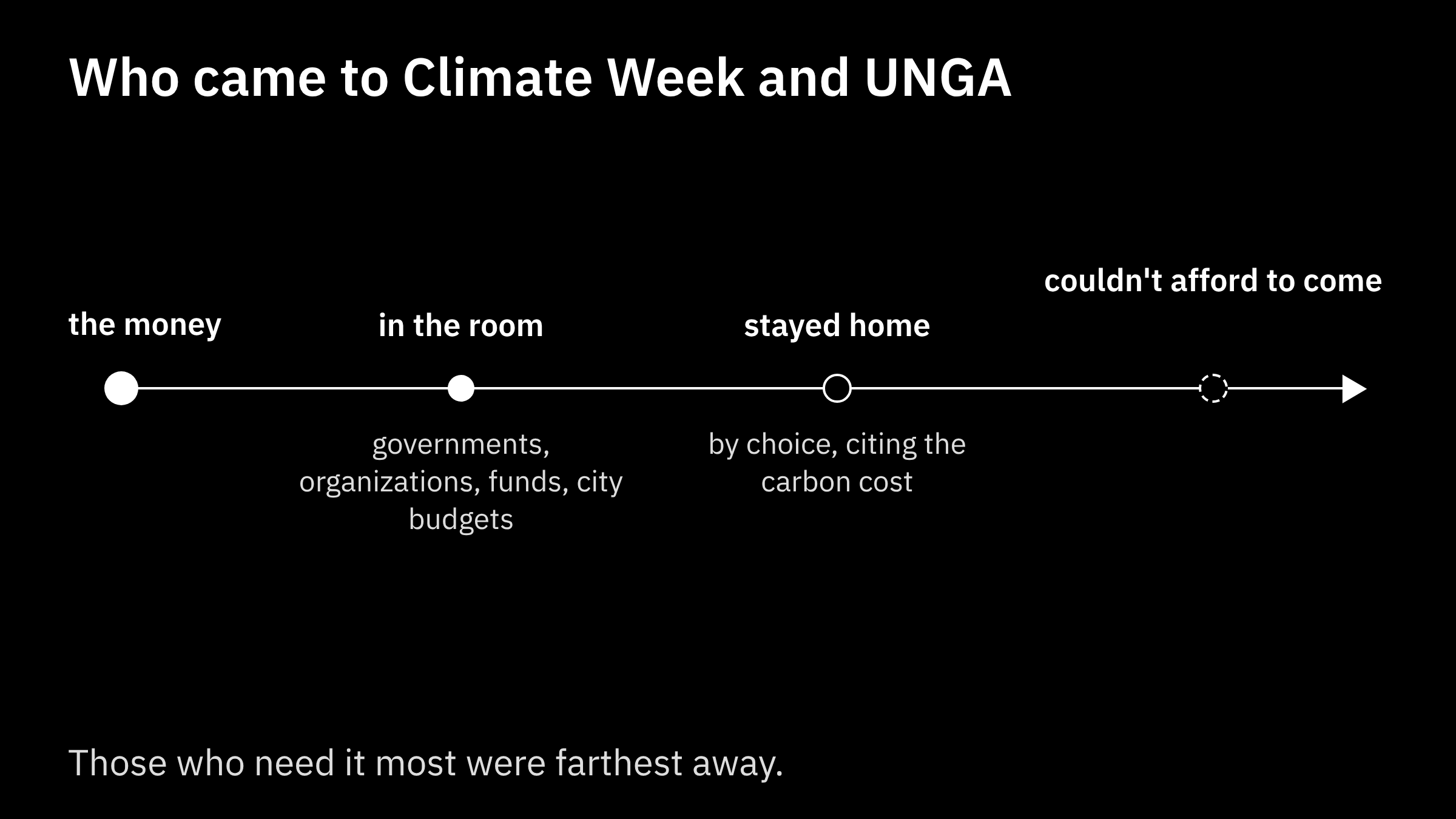
I read your posts. Many of you skipped Climate Week this year and said so, citing the carbon cost of the trip. The people I met in New York couldn’t skip it. They run organizations, funds and city budgets, and they came to find out where the money went. Some were in shock, some were grieving, and some had already moved on to building the next thing. The week ran past 1,000 registered events,1 and I spent it in some fun, chilly, cold, cozy, familiar, and strange rooms.
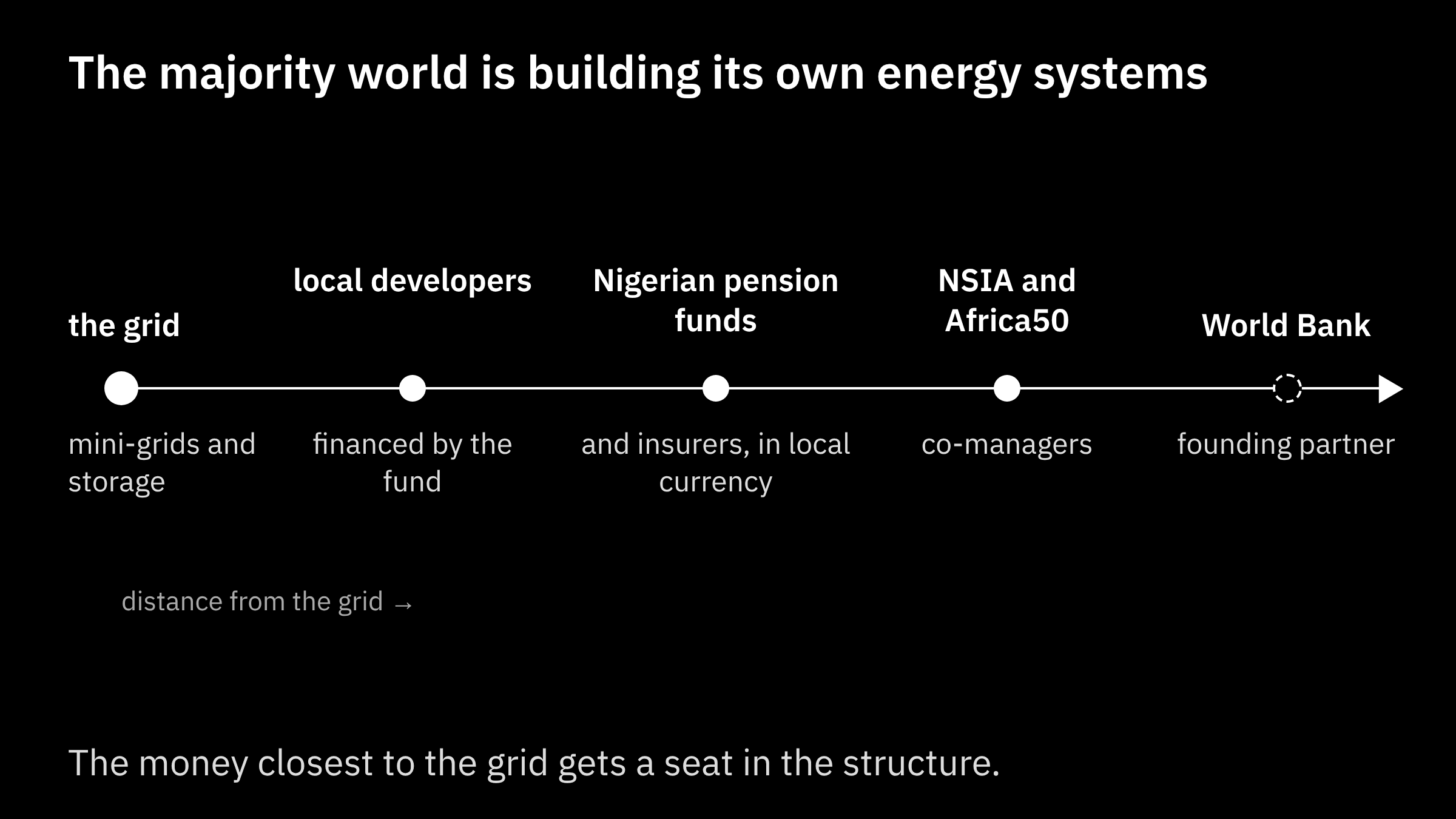
The majority world is building its own energy systems
The best energy of the week came from people in the majority world designing their own financial structures. On the sidelines of UNGA, the Nigeria Sovereign Investment Authority, the country’s sovereign wealth fund, and Africa50, a pan-African infrastructure investor, launched a $300 million fund for solar mini-grids and storage.2 The World Bank is a founding partner, and the fund feeds Mission 300, the World Bank and African Development Bank’s drive to connect 300 million Africans to electricity by 2030.3 Nigerian and African institutions manage it, and they built it to draw on Nigerian pension funds and insurers, in Nigeria’s own currency, and to lend to local developers.4 The money closest to the grid gets a seat in the structure.
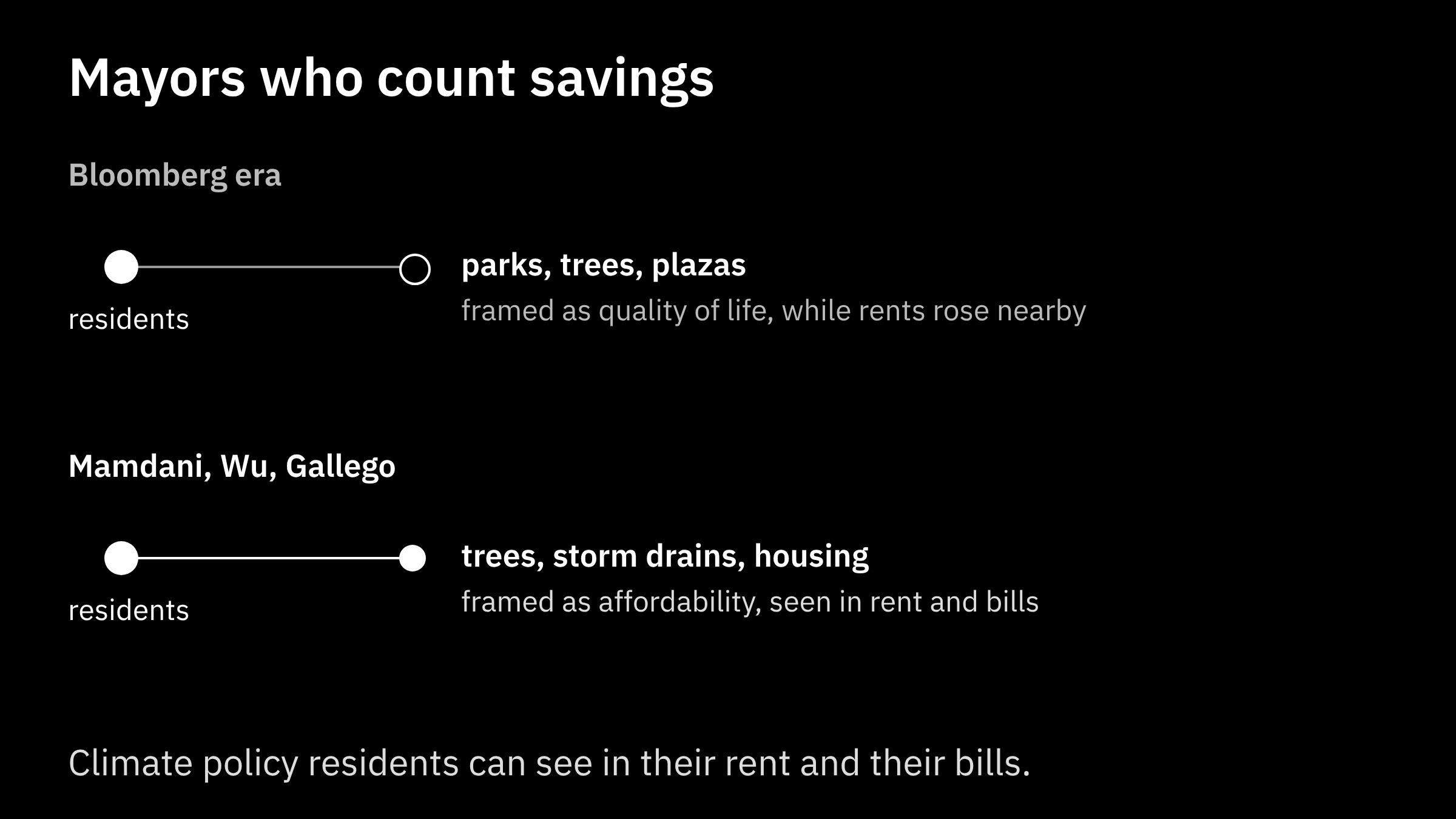
Mayors who count savings
At the New School’s Climate Week keynote, the Honorable Zohran Kwame Mamdani opened the morning, the Honorable Kate Gallego of Phoenix spoke on AI’s hidden toll, and the Honorable Michelle Wu of Boston closed on already completed lower energy bills, free buses, and retrofits in housing to improve the housing stock.5 I kept comparing them to the Bloomberg era. PlaNYC set a citywide emissions target and planted trees and built parks and plazas as quality of life, sometimes while rents rose nearby.6 Its congestion charge died in Albany after outer-borough residents objected to paying it. The charge came back under Governor Hochul in 2025. In its first year it kept about 27 million vehicles out of Manhattan, raised $550 million for transit – with the backdrop of an overall affordability campaign as the winning political idea.7
This group made the same kind of work about affordability attached to climate change. Mamdani told the room that climate “drives up the price of life,” and he talked about southeast Queens, where coastal flooding hits hardest. In ten months his administration has planted more trees than the city managed in any year of the last decade and put $108 million into storm drains.8 Wu does the same in Boston. She shows people what they save, and she retrofits housing with better environmental standards. That same week, mayors from 34 cities put housing first in their U20 communiqué and asked for climate and housing finance to come to cities directly.9 That version of climate politics survives a budget fight, because residents see it in their rent and their bills.
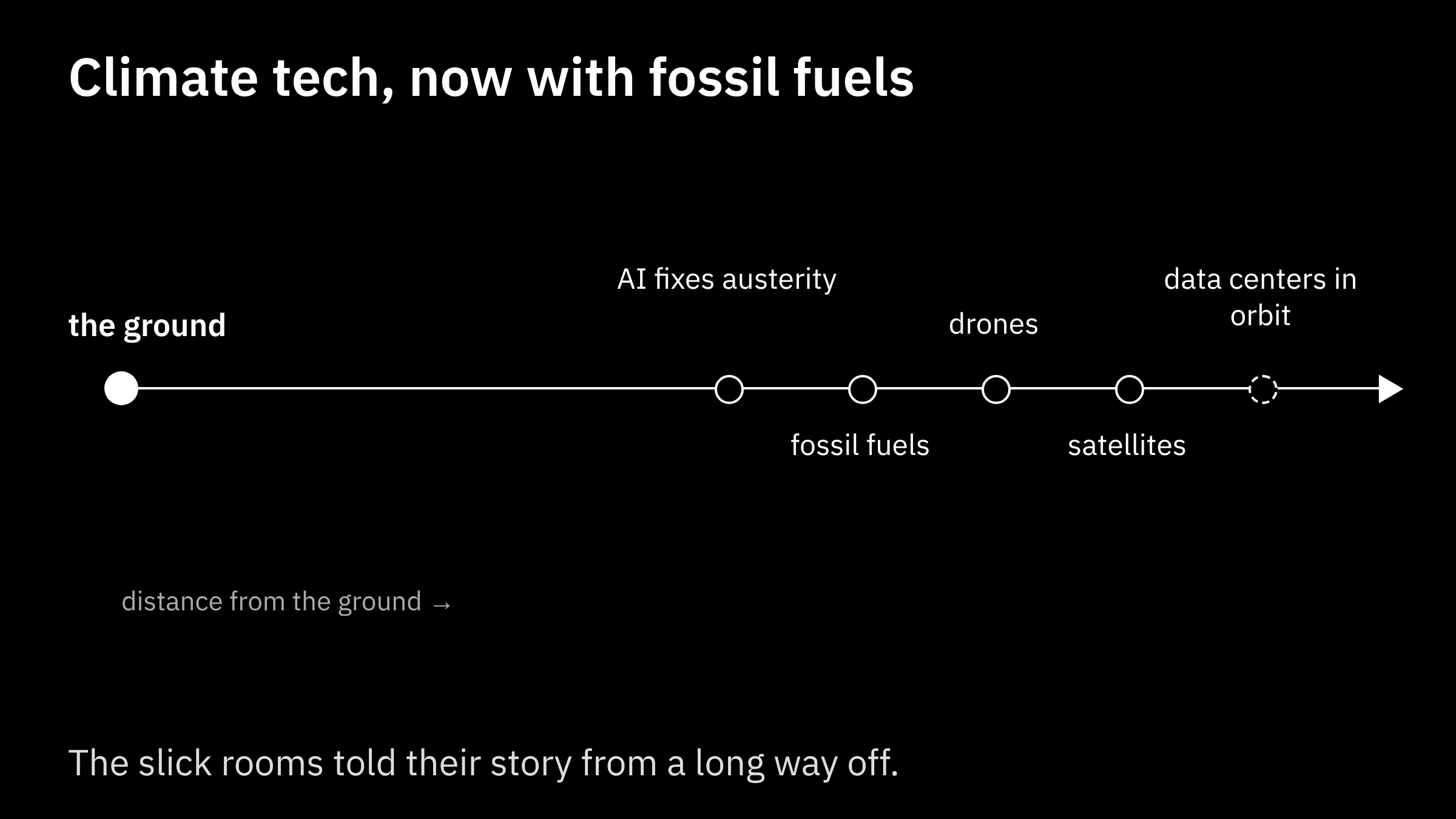
Climate tech, now with fossil fuels
Across town the mood turned slick and confused. The greenwashing events told a story that has captured too many: austerity can be fixed with AI. In the same rooms, climate also meant ramping up fossil fuels and building drones. Oh, and lots of satellites. And satellites with data centers on them, and instant solve for this proximity problem. There’s no need for community building in space, funding for local projects, or need for participatory work to get the voices of the people. Nobody on stage seemed troubled.
The trees in Phoenix
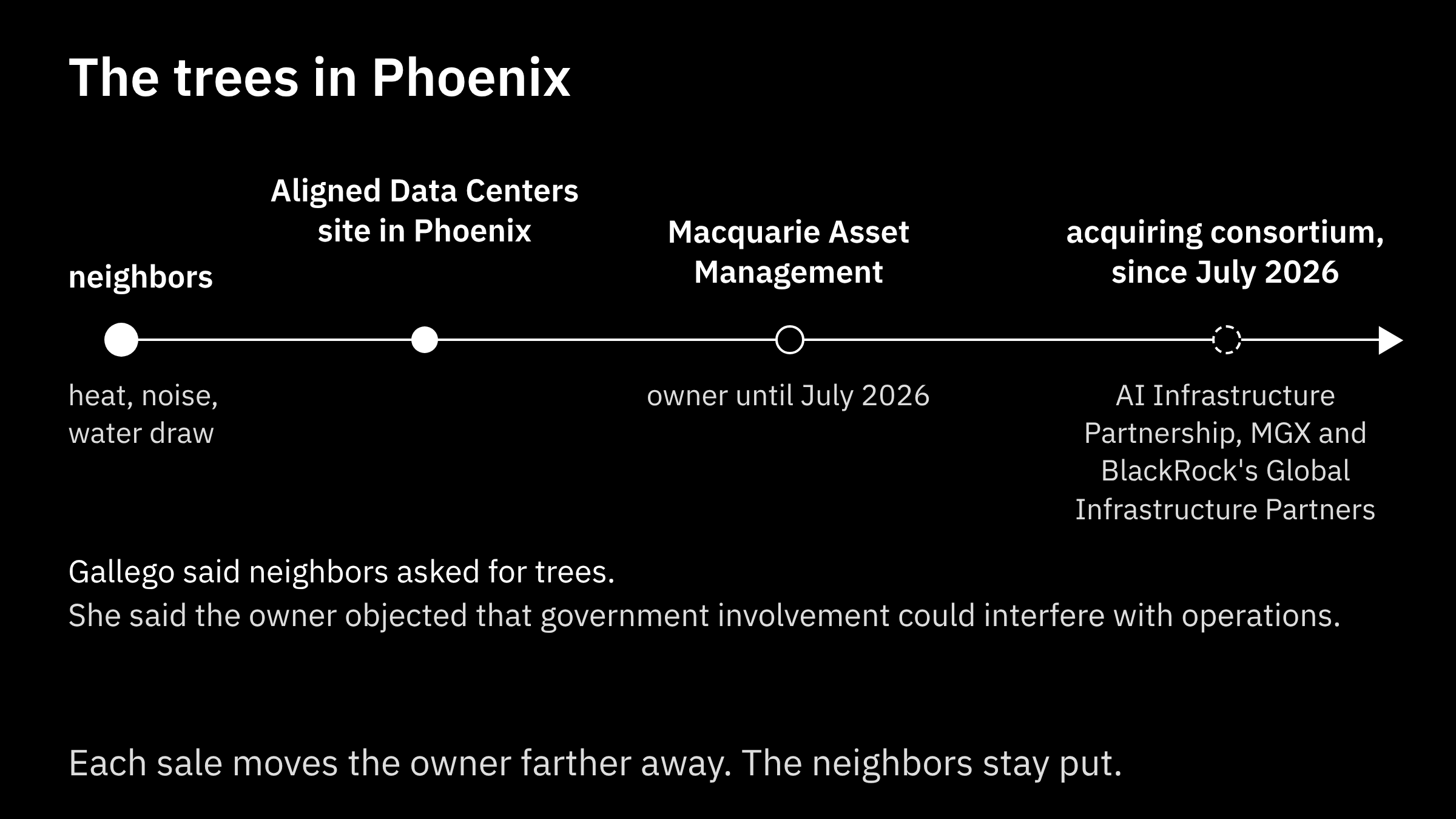
Mayor Gallego described residents near a Phoenix data center asking for landscaping. The city took their request to the owner, Aligned Data Centers, then controlled by Macquarie Asset Management.10 By her account, Macquarie objected that government involvement would interfere with operations. Gallego suspected the trees would not have survived the heat and the lack of water. I haven’t been able to verify that exchange, or her report that some financiers joked they couldn’t find Phoenix on a map.
Macquarie had owned Aligned through its Macquarie Infrastructure Partners funds since 2018. In October 2025 it agreed to sell the company at an enterprise value of about $40 billion, and the sale closed in July 2026 to a consortium of the AI Infrastructure Partnership, MGX and BlackRock’s Global Infrastructure Partners.11 The sale came as local opposition to data centers spread across the country,12 and the next owner inherits that fight along with the buildings.
The neighbors have no exit. While yes, my most technically rational friends can tell you that this problem has been solved, that future data centers will not need this much water, nor emit much carbon, nor create this much heat; recognize you are living in a speculative future that is not what is experienced in Phoenix, Virginia, Memphis. They live with the heat, the noise, the water draw and the bare ground, with these elements contributing to the asset’s value every day it runs, with nothing on the books to show for it.
Grieving and building
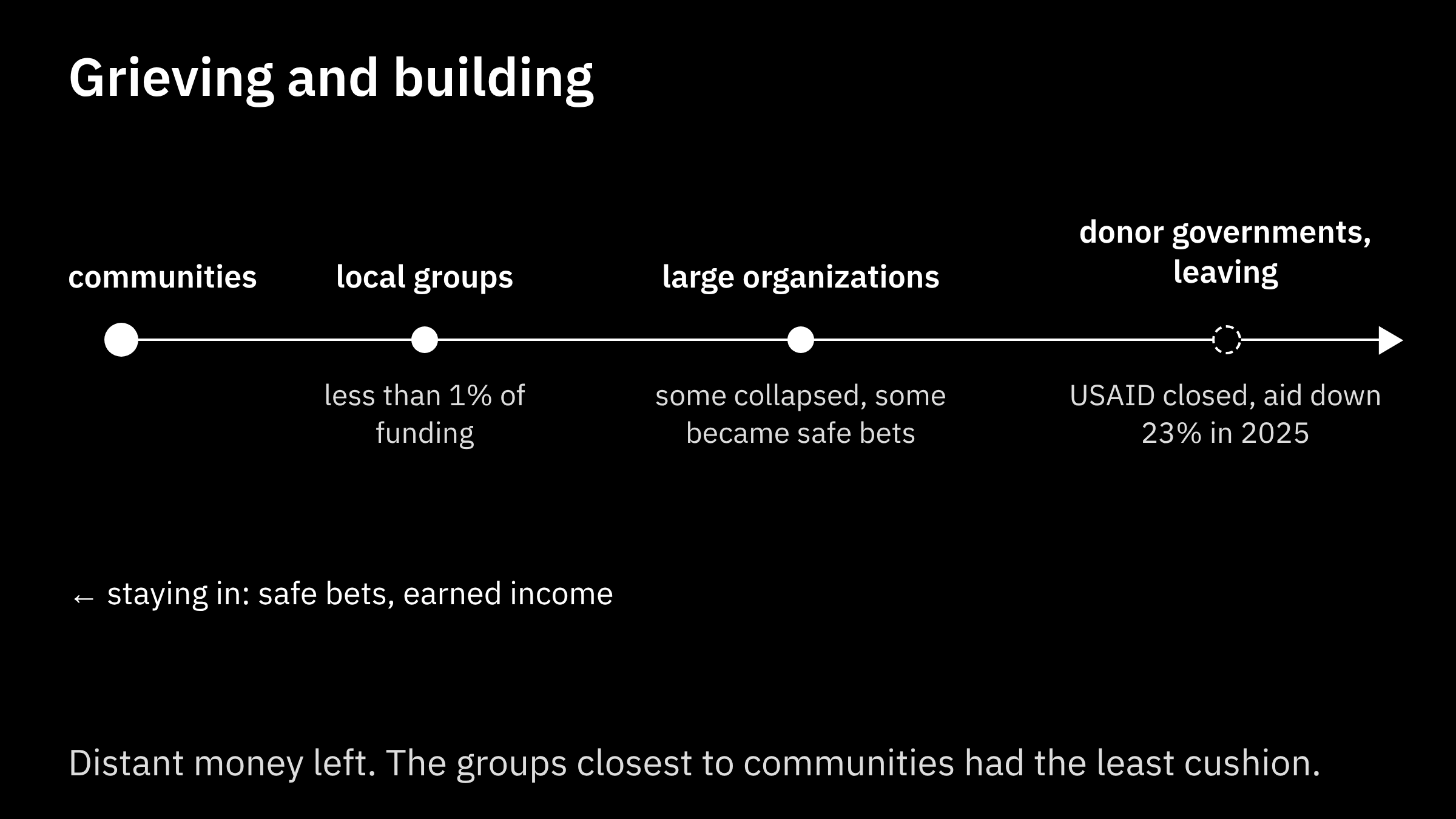
Around UNGA and various outside events, international NGOs and civil society groups were grieving programs they had spent decades building. More than a year after USAID closed, aid from wealthy countries is still falling. It dropped 23% in 2025, the steepest decline on record, with 17 EU member states cutting theirs and many pointing to the build out of bigger defense budgets.13 The OECD expects another drop in 2026, a third straight year of decline, which has happened only once before, after the Cold War.14
The shock in those rooms was still raw. Size protected no one. Some large organizations collapsed, and some small ones closed. A few became the safe bets that remaining funders doubled down on. A smaller group had already found other sources of revenue, including earned income, and spoke about the cuts as something they hadn’t planned for, but that perhaps this way forward was better. The groups closest to communities, which received less than 1% of total funding last year, had the least cushion and in many cases the most urgency to build something new.15
Who has to stay
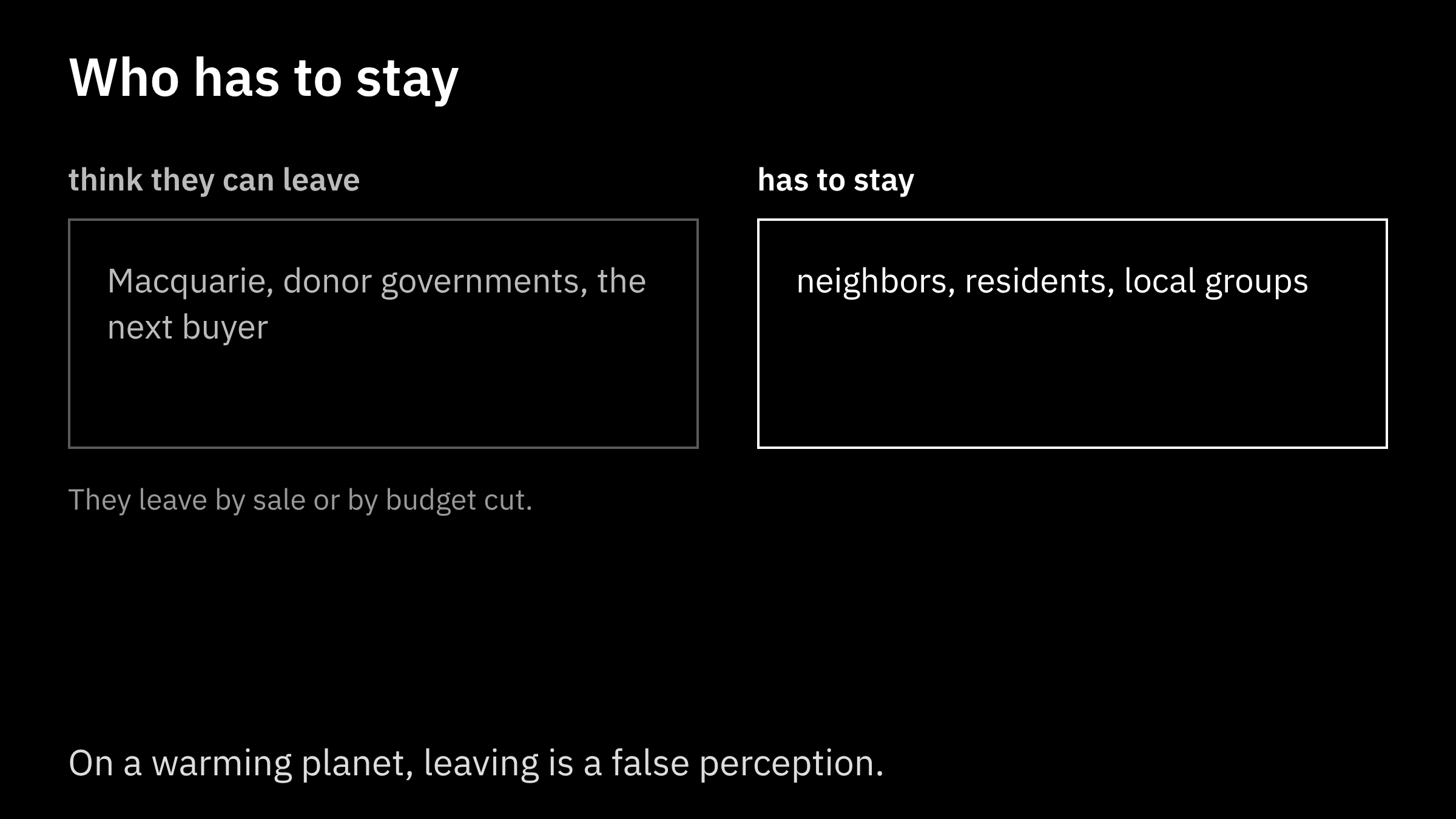
Distance ran through the whole week. Mayor Wu retrofits housing for residents who vote her in or out. Nigeria’s sovereign fund finances developers on its own grid. Owners that close can see what their assets do to the people around them, and they change course when conditions change. Distant capital adapts by remaining distant. A fund sells, a donor government cuts its aid budget, and the costs stay with people who live closest to the consequences.
That distance rests on a false perception. Every owner, however far away, depends on the same earth, and the heat, the floods and the lost harvests reach the portfolio, now.
An adaptive political economy would start with the people who have to stay. They know the heat, the water and the ground, and they will still be there when the next owner arrives. Capital that depends on a place should be built around them, as owners and stewards. If there was ever a time to build local judgment about systems survivability into the decisions that move capital, it is now.
- Climate Group, About Climate Week NYC 2026.
- SEforALL, “Nigeria DRE Fund reaches commercial launch milestone,” September 20, 2026.
- Voice of Nigeria, “Nigeria’s Renewable Energy Fund Begins Commercial Operations.”
- SEforALL, “NSIA, SEforALL, ISA and Africa50 unveil US$500 million DRE Nigeria Fund,” March 12, 2025.
- The New School, Climate Desk Live: AI, Energy, and Our Fight for Democracy and a Healthy, Affordable Future, September 24, 2026.
- PlaNYC; City of New York, PlaNYC Progress Report 2008.
- Associated Press, “New York’s congestion toll into Manhattan upheld by a federal judge over Trump’s objections,” March 3, 2026.
- Greer Walby, “Mayor Mamdani opens The New School’s Climate Week 2026 Keynote Event,” New School Free Press, September 29, 2026.
- NYC Mayor’s Office, “Mayors from around the world unite to demand the power to deliver,” September 2026.
- Kate Gallego, remarks on the “AI’s Hidden Toll” panel, Climate Desk Live, The New School, September 24, 2026. Author’s notes.
- Macquarie Asset Management, “Macquarie Asset Management to lead sale of Aligned Data Centers at an enterprise value of US$40 billion,” October 15, 2025; “Macquarie Asset Management announces successful close of Aligned Data Centers transaction,” July 21, 2026.
- Opposition to AI data centers, citing a March 2026 Gallup poll; Ground News, “Data center protests go national.”
- OECD, ODA projections for 2026 and the near term, June 19, 2026; CONCORD, “The EU sails away from international cooperation,” April 9, 2026; Newsweek, “Europe follows Trump on development aid cuts.”
- OECD, ODA projections for 2026 and the near term.
- Statewatch, “UN report warns of ‘existential threat’ to civil liberties,” February 2026.