

“The crisis consists precisely in the fact that the old is dying and the new cannot be born; in this interregnum a great variety of morbid symptoms appear.” -Gramsci
Everyone quotes Gramsci now. It has become the default frame for this moment, a preferred sign-off on an email signalling that you know there is a collapse of the liberal order, rise of authoritarianism, institutional rot, the messy middle. Žižek later translated “morbid symptoms” as “monsters,” which is more quotable but less precise. Morbid symptoms are what you get when the body is failing but has not yet been diagnosed. Monsters at least imply something you could fight in the boss level of a game. Symptoms just persist, like our compound co-morbid chronic conditions.
Adam Tooze recently refused this frame. An interregnum, he argued, implies another regnum afterward. It assumes the cycle turns. It promises that disorder resolves into a new arrangement. He does not see why we are entitled to that assumption.
“I’m dying on the hill that we’re not even in an interregnum because an interregnum implies another regnum afterward. It implies a vision of history that has this as an ellipse between two. I don’t see why we would feel that we are entitled to make that assumption.”- Tooze.
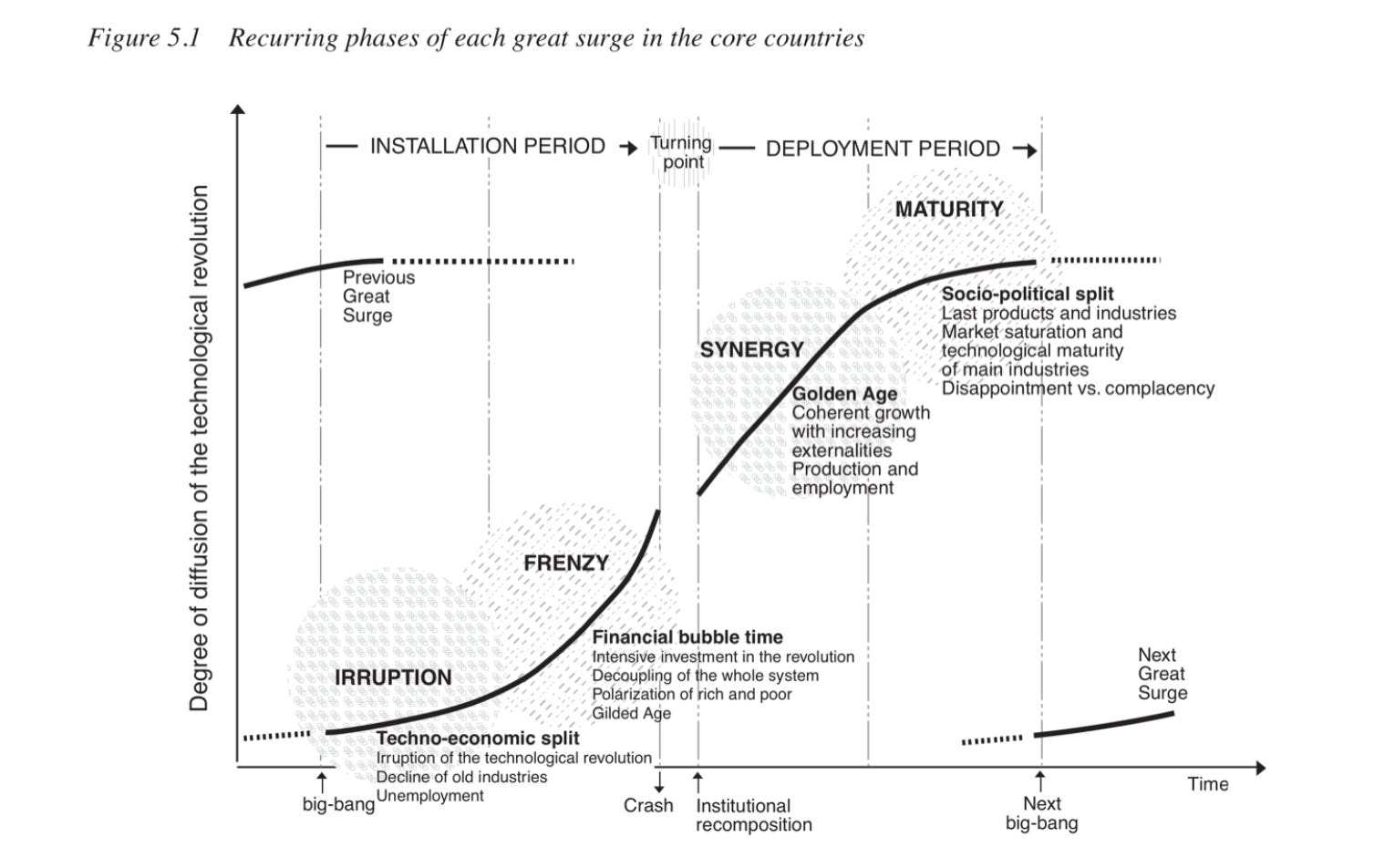
Nicolas Colin, in his Drift Signal newsletter on this platform, lays out the economic version of this question through Carlota Perez’s framework of technological revolutions. Perez recently argued that we are in something like the 1930s. The crises of 2000 and 2008 should have been the turning point, with speculative capital giving way to productive capital and governments building institutions to distribute the gains of the information revolution broadly. That is what FDR did with the New Deal. But no leader distributed the gains this time around. It was the banks that got bailed out. The Golden Age is still ahead …
Colin thinks we are closer to the 1970s. The paradigm is mature. The winners are entrenched. Innovation is sustaining, not disruptive. If he is right, this wave is spent, and the real question is what revolution comes next.
Both positions assume the cycle has a shape. If it is the 1930s, the good part is ahead. If it is the 1970s, the good part is behind. Either way, something follows.
I am not sure it does.
In the mid-1990s, I was in my mid-twenties, typing an equity research report about the future of the internet on a computer that was not connected to the internet. Nobody found this strange at the time.
The report was for Netscape. The company had five revenue streams, none of them proven, and the IPO document itself cheerfully noted that Microsoft would probably crush it, like a bug. My boss said, “Our job is to frame the shape of the curve.”

He meant the growth curve, the narrative that would justify a valuation for a company with five spindly potential revenue streams. I typed it out. I was just a bit player, not instrumental, and the momentum was already believed. The stock went crazy. The founders became multi-millionaires. One of them now controls roughly 18% of all venture capital as an asset class and advises the current administration on technology, AI, crypto, and higher education policy.
The logic designed in that room was a narrative-driven valuation, abstracted from costs or even reasonable assumptions for growth. You did not need to know which customer would take the lead or the details of how the technology worked. You needed the story. You framed the curve, raised the round, and moved on.
That logic did not stay in one room. It became the operating system of venture capital and early-stage technology companies, hence how we think about innovation itself. Finance shaped the wave, but it could not control what the wave became.
Perez has a mechanism for how speculative phases end: political crisis forces institutional rebuilding. The crisis arrived in 2000 and again in 2008. But the instrument had already done its work. It had produced enormous wealth, and that wealth had converted to power. The people the instrument made rich became the people who governed the crisis response. The mechanism that should have forced restructuring was captured by the logic it was supposed to restructure.
The speculative logic did not give way to production; it became production. Each crash produces not restructuring but more liquidity, more narrative, more abstraction from relationship. The bubble does not pop into a Golden Age. It reinflates. It has one move, and the move works every time.
This is what I think Tooze is sensing from the geopolitical side and what Perez’s framework, for all its elegance, cannot quite account for. The cycle is not delayed. The instruments designed in the last wave broke the mechanism that was supposed to produce the next phase. There is no deployment because the installation phase captured the transition.
If that is where we are, then the question is not where we sit in the cycle. The question belongs to the people building civic infrastructure, community health systems, intergenerational housing, distributed energy, care networks, local food systems, resilience work of every kind; people designing things that have to function for the communities they serve, inside an economy that keeps rewarding abstraction from consequence. They, we, do not have the luxury of waiting for the cycle to turn. We are building now, with instruments that were not designed for what they are trying to do.
I wrote this piece and then, as an experiment, rewrote it from a perspective that agrees with every structural claim but draws the opposite conclusion. Marc Andreessen, the co-founder of Netscape, now 18% of all venture capital as his firm’s assets under management in the US, might sign the same diagnosis: narrative-driven valuation, wealth converting to power, the cycle not turning. He would call it progress. The fork is not in the analysis. It is in who you think the builders are.
Who? Whose?
Whose narrative(s) of abundance?
Whose future(s)?
Whose imagination(s)?
—-
Gramsci, A. (1971). Selections from the prison notebooks (Q. Hoare & G. Nowell Smith, Eds. & Trans.). International Publishers. (Original work written ca. 1930–1932).
Žižek, S. (2010). A Permanent Economic Emergency. New Left Review, 64.
Yes, I know we are sick of Ezra, but sending you there anyway, and you can just read the transcript. Klein, E. (Host). (2026, January 30). Adam Tooze on the end of the magical thinking era [Audio podcast episode, written transcript]. In The Ezra Klein Show. The New York Times. https://www.nytimes.com/2026/01/30/opinion/ezra-klein-podcast-adam-tooze.html
Colin, N. (2024, May 21). Late-cycle investment theory. Drift Signal.
Perez, C. (2003). Technological revolutions and financial capital: The dynamics of bubbles and golden ages. Edward Elgar Publishing.
Thompson, B. (2021, May 25). The death and birth of technological revolutions. Stratechery. https://stratechery.com/2021/the-death-and-birth-of-technological-revolutions/
Whose Abundance Narrative
·
August 19, 2025

For those in community-centered design, participatory design, systems change, and finance, abundance/exponential thinking, post-growth, degrowth, hypergrowth – all of you.
Escobar, A. (2018). Designs for the pluriverse: Radical interdependence, autonomy, and the making of worlds. Duke University Press.
Benjamin, R. (2019, September 24). A New Jim Code featuring Ruha Benjamin and Jasmine McNealy [Transcript]. Berkman Klein Center for Internet & Society at Harvard University. https://cyber.harvard.edu/sites/default/files/2019-10/2019_09_24_RuhaBenjamin_Transcript.pdf