
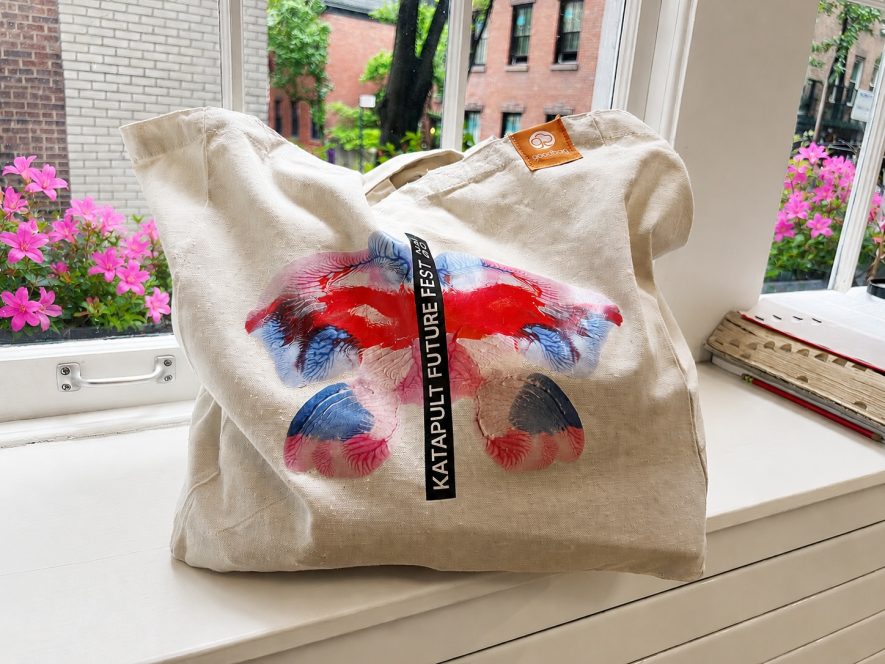
Notes from Katapult Future Fest, Investor Day, for the Misfits of Finance
Finance is a way of carrying the world by leaving most of it out. Reducing the noise is the skill. It is the first thing you are taught, and there are consequences for questioning it.
Portfolio is an Italian word. Portafoglio, from portare, to carry, and foglio, a sheet of paper. A portfolio was a thing you carried. Artists carry portfolios of drawings. Diplomats carry portfolios of state. The case implied a holder. The papers were gathered by someone, organized for someone, presented by someone. Hands were involved.
Finance took the same word in the other direction. It trained me to subtract.
As a young analyst I worked from five in the morning to eleven at night, and the whole point of those hours was to get the story down to a few numbers. There is a misunderstanding that finance is abstract, disembodied. Instead, it can be a full contact sport. It is, however about compression.
You took a whole company, a whole sector, and reduced it until you could walk onto the trading floor and say it with your body. Revenue lift. An earnings surprise. The opex margin. Whether the surprise was hiding in capex. Eighteen hours of analysis so that when the news hit I could communicate it in a few gestures, and everything that did not fit the gestures was noise to tune out.
The noise was the rest of the world.
Today, the stories are big, tale tales. A sector carrying civilizational narratives. A company promising to terraform another planet. The swings in the chip names. The volatility narrated on the radio over a soundtrack of stormy weather, as though it were happening to all of us at once. It is not weather. For the firms that make the markets, volatility is the season of higher volume and wider spreads. They are paid on the fees. The story finance tells about its own bad weather leaves out the people who are paid when it storms.
This year I held a session off to the side. A Misfits of Finance session, with Tayo Akinyemi, at Katapult Investor Day. We were placed about twelve minutes from the main stage, in a small wooden garden house, a Barbie-like house, a tuinhuis, in Tolhuistuin, on a person-made island.
I learned later what the main stage was standing on. The building near where Shell once ran its scenario plans. Pierre Wack built that practice in the early 1970s out of a discipline of perception. He believed the future could be seen by people trained to see it, and he trained Shell’s managers to see what their competitors could not: that a shock was coming out of the Middle East and the price would break. When it came, in 1973, Shell was ready. The scenarios did their work. What they were built for was survival in position, to come through the shock in the same place while slower firms were caught. All of that seeing served one thing, arriving at each break already positioned. The conditions that keep producing the breaks were never the subject. Shell widened perception to keep the aperture narrow.
This spring the shock came again. A war closed the Strait of Hormuz, the strait much of the world’s oil passes through, and the price ran past a hundred dollars and fell back and ran again, the markets lurching the way they lurch whenever the oil is in question. Fifty years of trained perception, pointed at exactly this, and the world arrives at the same chokepoint, more dangerous than the one Wack modeled, the storms closer together. The wider lens, the one that looks at what makes the weather and not only the next break in it, was never what the building was for.
Twelve minutes away, in the garden house, we were doing the opposite work. We asked people for the winding, non-traditional stories of how they had arrived. The invitation drew painters and photographers, ex-BlackRock, escapees of Wall Street and the City, and people like me, who found their way to a creative practice to repair the neurological damage of the analyst times, ten thousand hours squeezed into two and a half years, then more than twenty years of rewiring. What the artists gave us the courage to name: the wider view is the lens finance is going to need.
The portfolio finance taught me was the compressed one, shown clean, small enough to carry in a gesture. The portfolio the word actually means is the one with everything still in it. The systems problems, the structures, the history and what we are still learning of it. The care work that raises gendered and structural questions at once: whose contribution goes undervalued, who owns the infrastructure we depend on, what repair is owed for redlining and for the neighborhoods that line the corridors of dirty energy. Whether a society can keep its rule of law intact. I have carried some of these for years. None of them resolves into a number I could show with my hands on a trading floor. They are in the portfolio anyway. That is what a portfolio was always for.
So I have stopped keeping two of them. For a long time there was the portfolio for the numbers that survive compression, and a second container for everything that would not reduce. There was only ever one. The compressed portfolio is still inside it, the quick gestures intact, the direction of earnings, the margin, the line where the surprise hides. Compression is a useful tool and some mornings it is the right one. What changed is the size of what surrounds it. The numbers and the questions that refuse to become numbers travel in the same case now, heavier every year.
The bag I carried home from Ruigoord, with the butterfly on it, is on the windowsill beside me, still open.