
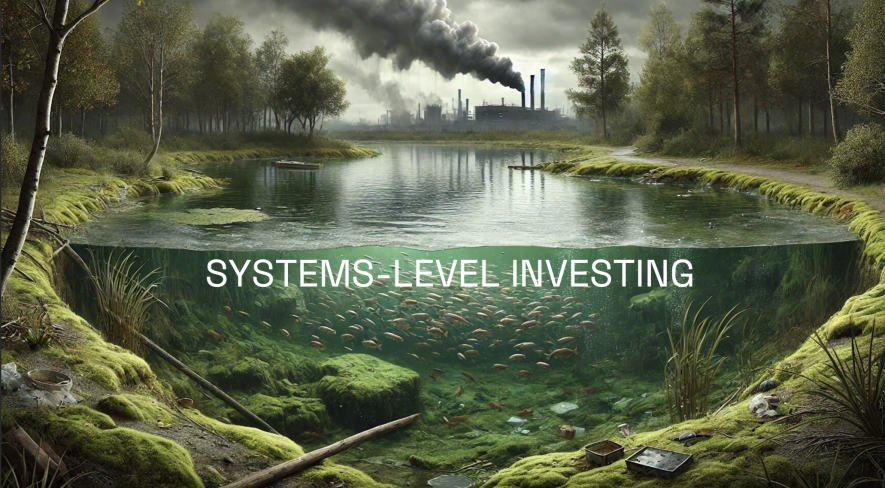
What happens when institutional investors become systems-conscious?
There is a book that circulates in certain rooms.1 It has been on my syllabus since I first started teaching, 17 years ago. It moves the way useful tools move, from hand to hand, without ceremony. Back when she was known as Dana, Meadows wrote it for people watching systems fail while the standard apparatus kept declaring success. I found it in the early days of green design, in the early 2000s, when the field was trying to think beyond material substitution, energy-efficiency calculations, and life-cycle assessments. Someone handed it to me, and the bathtub became the shape of every problem after that.
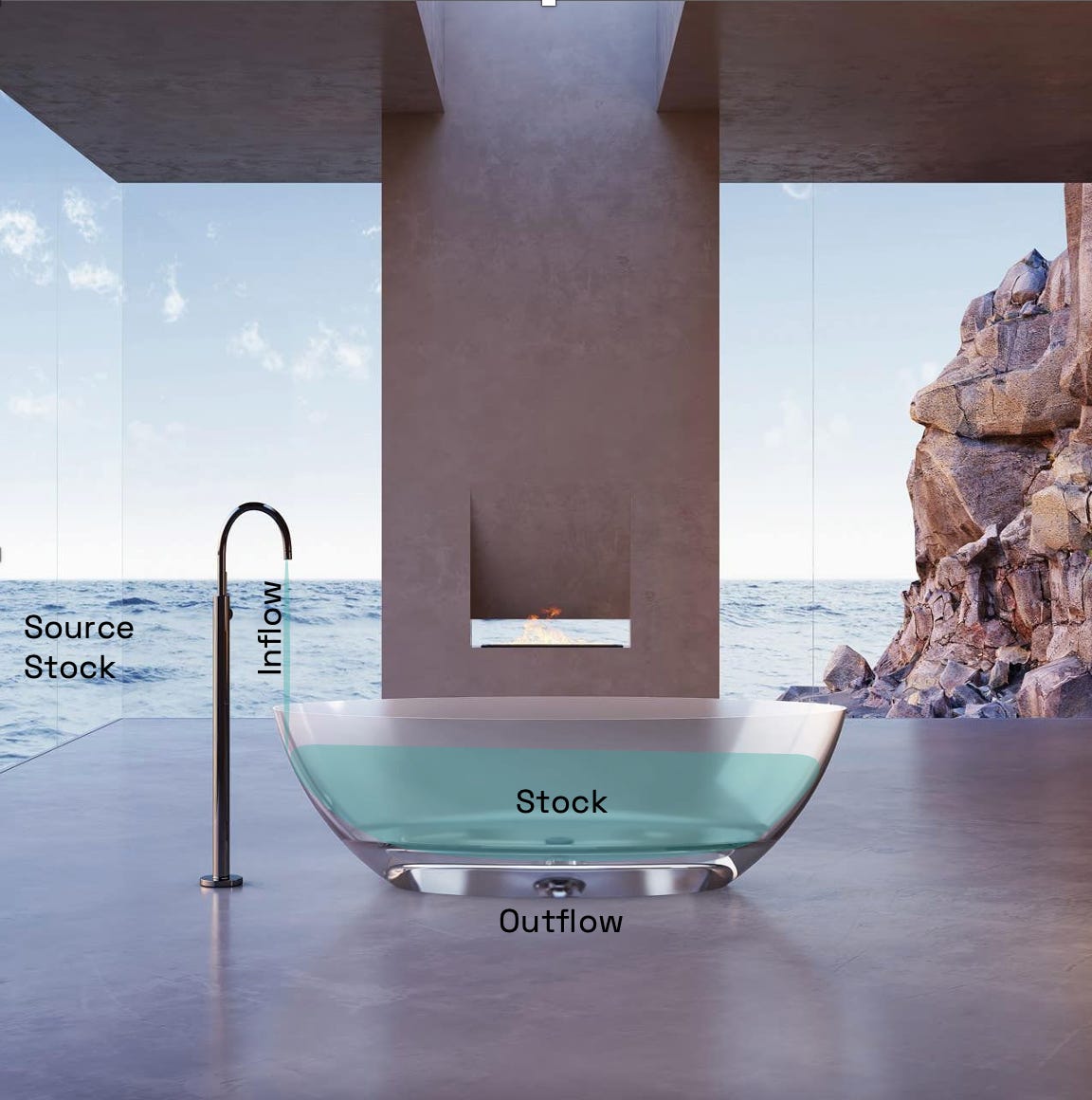
The bathtub is the central image: stocks, flows, the drain running while every intervention addressed the tap. A civilization organized around measuring movement, ignoring what is accumulated or depleted, building elaborate instruments for reading the wrong thing.
Contribution Design: I write about business models and financial architecture as a design problem, centering the people and systems that contribute to life.
This week at The Investment Integration Project event,2 more than three practitioners cited it without coordinating, definitely riffing. The bathtub has reached institutional asset owners.
I watched on a Zoom webinar. That is how unglamorous twenty years of vindication looks.
Modern Portfolio Theory is a more powerful metaphor than the Meadows bathtub. Every compliance framework, every performance window, every benchmark comparison ran through it.
A small number of institutions were quietly making decisions at civilizational scale, moving capital across systems that determined whether communities persisted, whether ecosystems held, whether the conditions for human life in the next century would be recognizable. They described this activity using the vocabulary of financial comptrollers: the prudent man, the reasonable rule, the risk-adjusted returns, the benchmark, and relative performance.
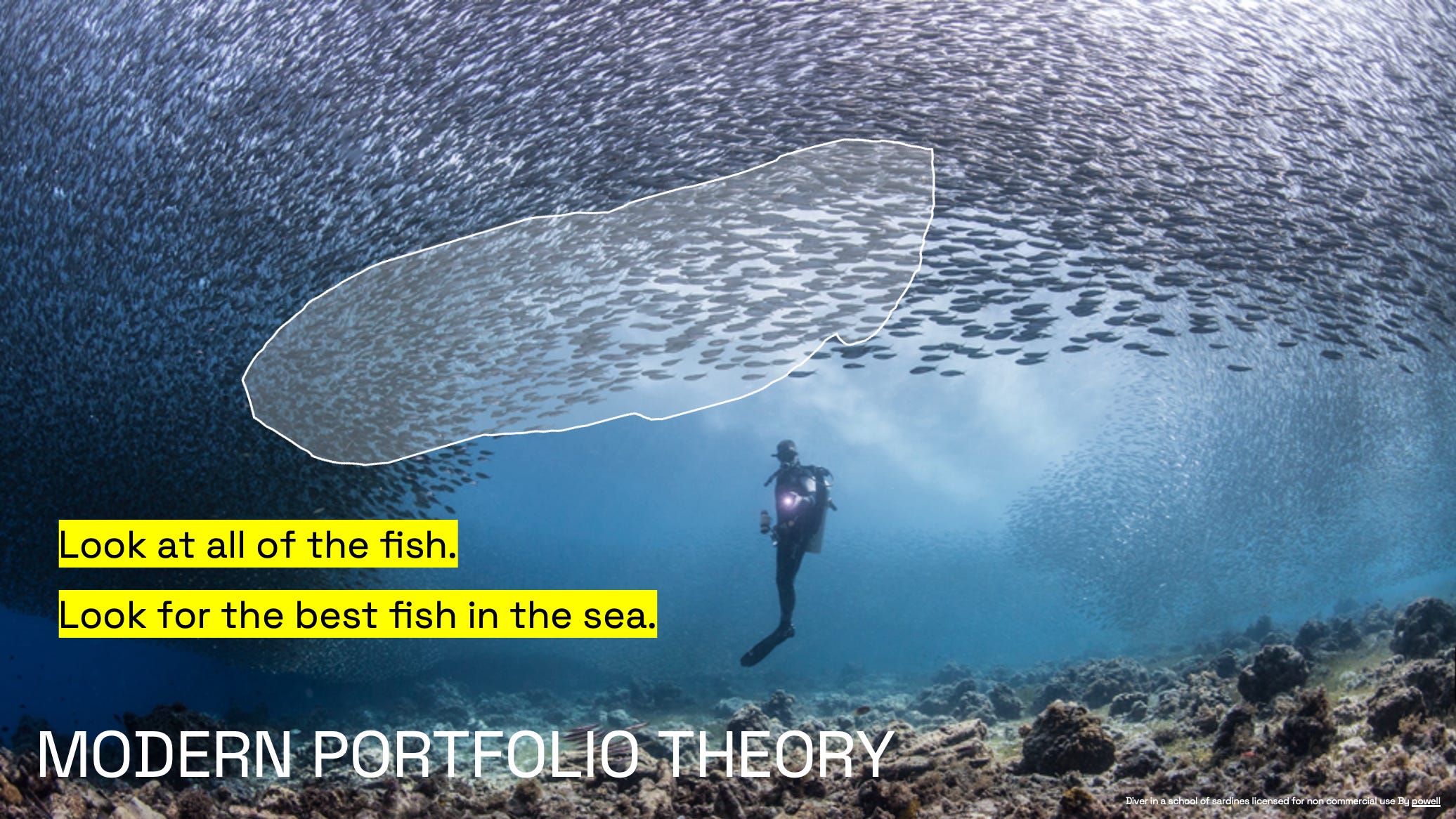
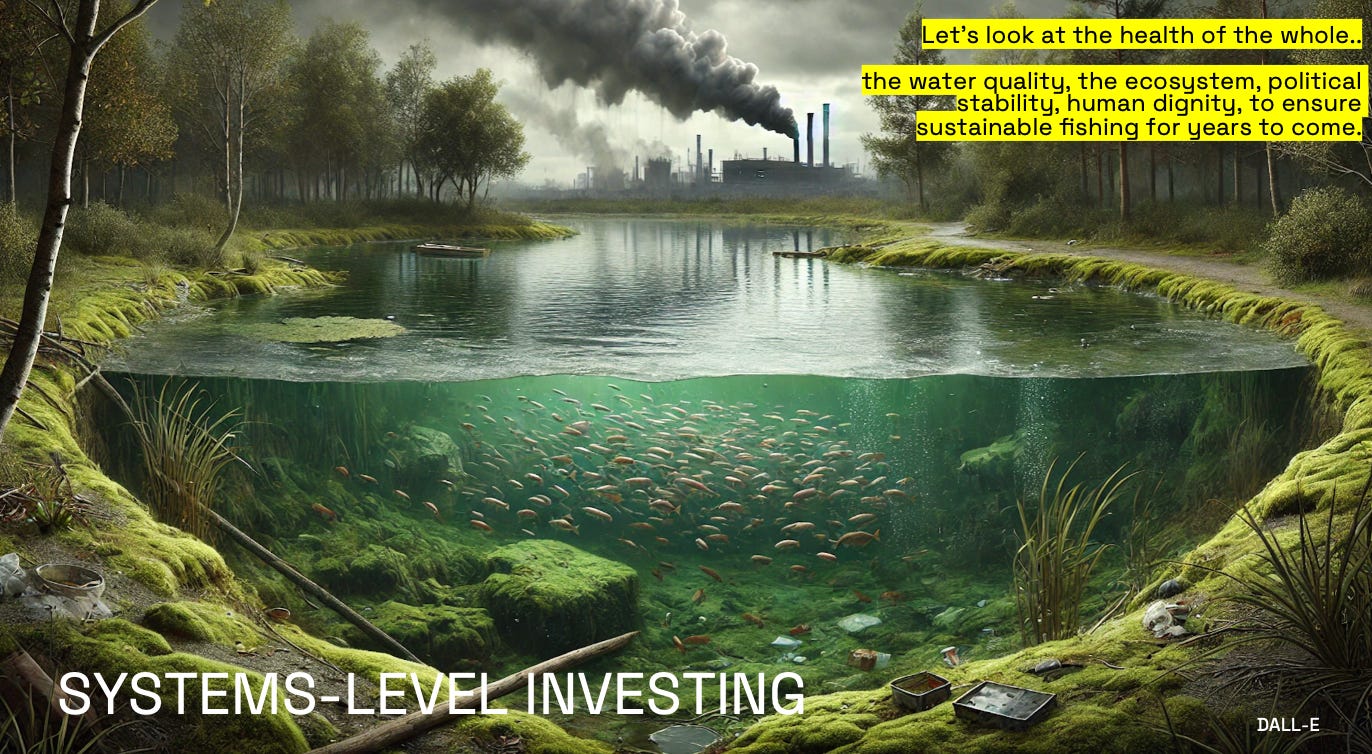
When we asked our university’s investment committee about investment screens, they balked. They liked MPT. “We like being able to fish for all the fish in the sea.” Please don’t put screens or constraints – it will be hard, and costly, to tell the managers of the funds to do something different, and impractical to screen out de minimus values-not-aligned investments. How else to get to the most Efficient Frontier?
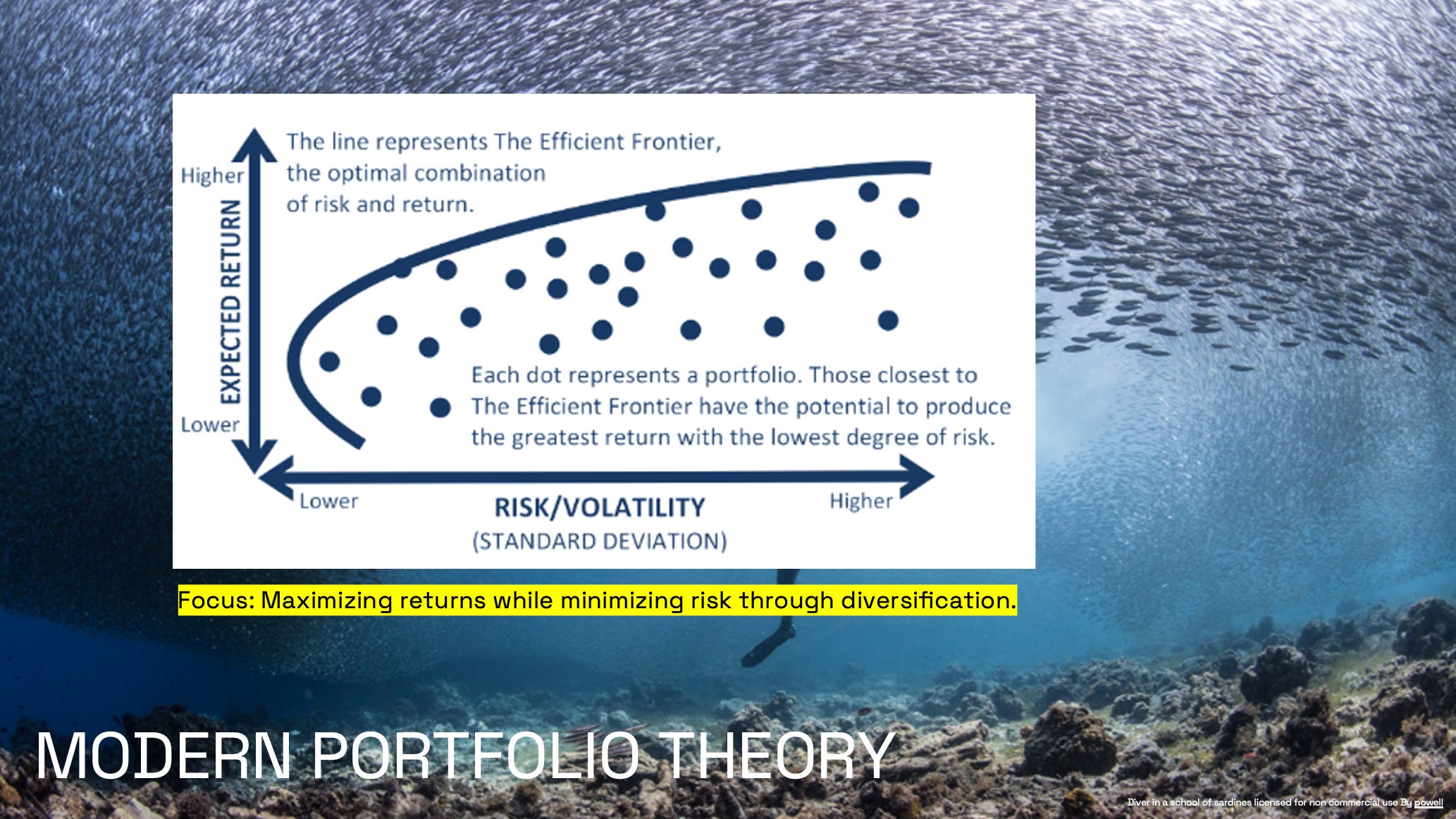
Holding up the wave with cello tape, the Efficient Frontier is a model of what is capturable right now. It has no register for what the fishing depletes, no mechanism for the drain running while the portfolio optimizes, no language for the stock that will not be there when the next generation of beneficiaries arrives to collect.
We have been so conditioned to see everything as temporary, as a service, as a metric moving in the right direction. The bathtub asks what accumulates. Stocks are what persist, what carry consequence across time, what build over decades or drain. Asset managers understand long-term horizons, whatever we say about short-termism in finance.
Flows move through. One can spend a career optimizing flows while the stock depletes. KPIs measure movement. They have no apparatus for what gathers, what erodes, or what the system is doing at the level that determines everything else.
ESG added variables. Better calibrated, more rigorously evidenced
We emptied the tub, and the field was rebuilt around better evidence. The metrics kept measuring movement while power accumulated elsewhere, while democratic capacity drained, while the rules that made the measurements meaningful were quietly up for renegotiation. The gods of capital allocation were optimizing portfolios as the water became undrinkable, killing all the fish.
Most investors adopting this systems-level investing practice have a portfolio theory of change. How does this allocation improve risk-adjusted returns for the beneficiaries – those pensioners depending on the pension? The second theory of change is the one the field has just started to develop: how does capital at scale reshape the dynamics of the system my beneficiaries depend upon? A programmatic theory of change for social equity, biodiversity, or financial stability, running alongside a capital allocation that reinforces the dynamics that perpetuate those problems, is one thing undoing the other.
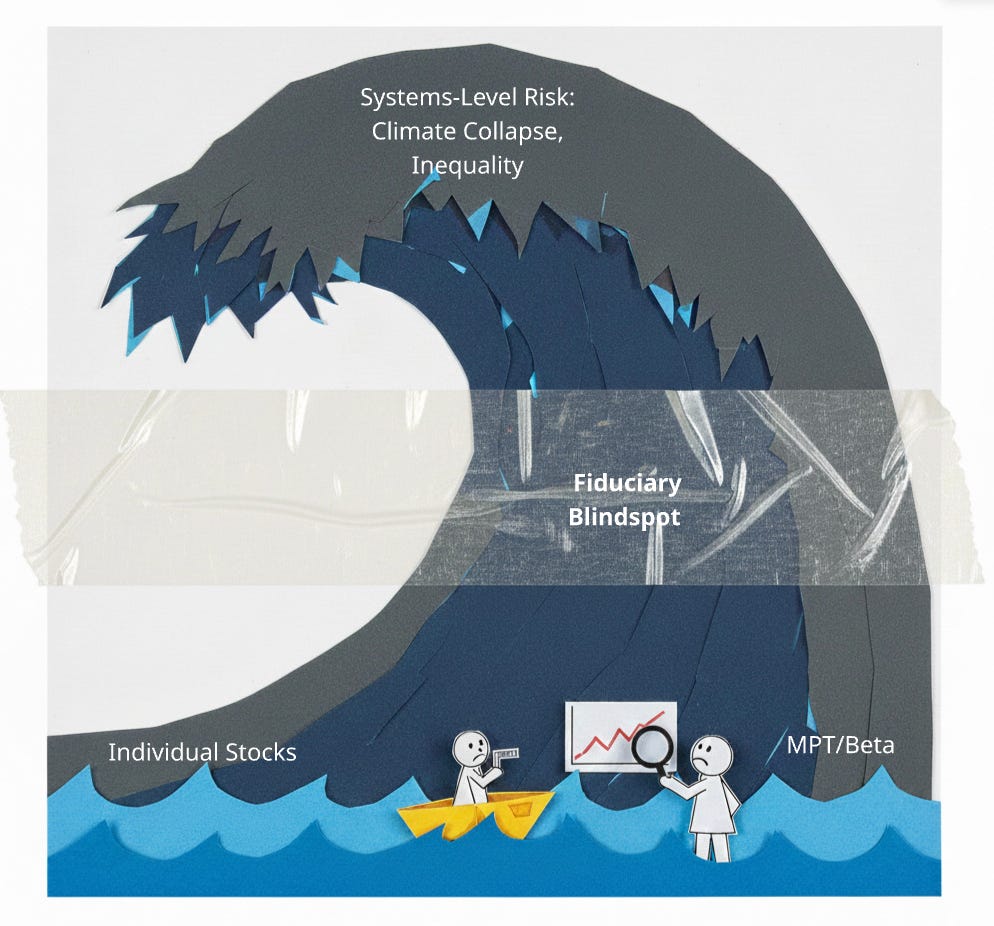
Why it’s hard to see systems-level risk when you’re only looking at a portfolio
Two people are doing their jobs. One is picking individual stocks, the other is managing a portfolio using Modern Portfolio Theory, the standard framework that says if you diversify across enough assets, you can manage risk. Both are doing exactly what the financial system trained them to do.
What neither of them can see, because the system they work inside has no mechanism for seeing it, is that the biggest risks to their portfolios are not at the level of individual companies or even diversified portfolios. Climate collapse and runaway inequality are what economists call systemic risks. They affect everything at once. You cannot diversify away from them because there is nowhere else to put the money. The whole ocean moves.
The tape across the middle of the image is the fiduciary blind spot: the legal and professional framework defining what fund managers are responsible for has a gap. It was designed to protect beneficiaries from bad stock picks and mismanaged portfolios. It was not designed to reckon with forces that operate above and beyond any individual investment decision. So the wave builds, and the framework looks the other way, out of the limits of what it was built to help us see.
The tape is holding back nothing.
At TIIP, Genevieve Hayman of CFA Institute questioned the view that capital allocation is neutral. “Investors don’t observe markets; they co-constitute them. Capital is the input that shapes the dynamics in the market.” If investors recognize their role in shaping market dynamics, then the tool is the management of systemic risk: portfolio allocation that steers markets towards better outcomes.
People making decisions about capital at scale reshape systems. The people in that room are architects of the conditions in which markets operate. They have always been playing at a civilizational scale. The question now is what to do differently. We are told they don’t want to wait for three-horizon frameworks or icebergs. They want to move.
TIIP has been building toward this since 2015. The handbook3 they launched today is a decade of practitioners writing honestly about what they got wrong, alongside what they got directionally more right. The questions in that room were about how one embeds a capital markets theory of change into governance structures, how one makes the structural lever something a trustee can reach in a quarterly investment committee meeting, how the Archimedes handle becomes operational.
But there is a recognition that the rules of materiality got rewritten by enforcement. Fiduciary duty became a political instrument. The power that had always been operating beneath the technical vocabulary stopped being polite about it. More evidence is not needed. Markets are shaped by power. Narratives move capital. More data was never going to be sufficient on its own.
Meadows described this problem before most of finance was willing to form the question- the power to transcend paradigms it the biggest lever of change. The bingo card filled up on a Zoom webinar on a Tuesday morning
From Meadow’s own description of why she created this list first published in Whole Earth then updated in 1999:4
So one day I was sitting in a meeting about how to make the world work better — actually it was a meeting about how the new global trade regime, NAFTA and GATT and the World Trade Organization, is likely to make the world work worse. The more I listened, the more I began to simmer inside. “This is a HUGE NEW SYSTEM people are inventing!” I said to myself. “They haven’t the SLIGHTEST IDEA how this complex structure will behave,” myself said back to me. “It’s almost certainly an example of cranking the system in the wrong direction — it’s aimed at growth, growth at any price!! And the control measures these nice, liberal folks are talking about to combat it — small parameter adjustments, weak negative feedback loops — are PUNY!!!”
Suddenly, without quite knowing what was happening, I got up, marched to the flip chart, tossed over to a clean page, and wrote:
PLACES TO INTERVENE IN A SYSTEM
(in increasing order of effectiveness)
9. Constants, parameters, numbers (subsidies, taxes, standards).
8. Regulating negative feedback loops.
7. Driving positive feedback loops.
6. Material flows and nodes of material intersection.
5. Information flows.
4. The rules of the system (incentives, punishments, constraints).
3. The distribution of power over the rules of the system.
2. The goals of the system.
1. The mindset or paradigm out of which the system — its goals, power structure, rules, its culture — arises.
.
Perhaps, some people are recognizing, as Meadows did with NAFTA way back when, that we can admit that we were pushing in the wrong direction.
This is all good news. The room exists. The vocabulary is traveling. The admission is happening in institutions that spent a century avoiding it. You can’t unsee a bathtub, a depleted aquifer, a polluted ocean, a wave.
And if you are sitting on a systemic investing opportunity right now, watching this from wherever you are, this moment of institutional readiness has never felt further away or stranger. The room that took more than 25 years to arrive is finally here. The capital it represents is still, for the most part, being held in luxury bathtubs, hidden from view.
A small group of us is trying to do something about the gap between the room and the drain. FEST: Financing Ecosystems for Systemic Transformation5 is a network of 150+ practitioners across 30 countries: ecosystem stewards, philanthropic funders, institutional investors, and systems weavers; the full range of roles that financing ecosystems require.
Right now, we are building the shared infrastructure the field is missing: a fellowship program that funds participation in the convenings where this field is being built, so the people with the deepest contextual knowledge are in the room, not watching from outside it. Each funded practitioner weaves connective tissue between events, organizations, and communities of practice before, during, and after. The work is at the top of Meadows’ list: not parameters, not feedback loops, but who holds power over the rules and whether the system’s goals can change. We are also, unglamorously, in the plumbing.
Meadows, D. (2008). Thinking in systems. Chelsea Green Publishing.
Lukomnik, J., & Burckart, W. (2026). The handbook of system-level investing: How experts worth trillions of dollars are rethinking investing. Miniver Press.