Model-as-a-Service

Models-as-a-Service

The Model-as-a-Service archetype of business models provides pre-trained machine learning models, made available as services over the internet, for free, bundled, or for a fee. 

Model-as-a-Service is not New to Foundation Models, the Newest Type of AI Offering

Note: given the rapid adoption and fervor in the space, we will update this post more frequently vs. other more evergreen business model library tear-downs. Last update: December 21, 2024

Artificial Intelligence (AI): Artificial Intelligence refers to the simulation of human intelligence in machines that are programmed to perform tasks that typically require human intelligence, including subfields such as machine learning, natural language processing, computer vision, robotics, and more.

Machine Learning (ML): Machine Learning is a subset of AI and focuses on the development of algorithms that allow computers to learn from data and improve their performance on a specific task over time without being explicitly programmed. ML algorithms use statistical techniques to identify patterns and make predictions or decisions based on the patterns observed in the data.

Deep Learning: Deep Learning is a specialized subset of machine learning which involves the use of artificial neural networks with multiple layers to process and learn from vast amounts of data. Deep learning has been particularly successful in tasks such as image and speech recognition, natural language processing, and winning complex games like Go and Chess.

Foundation Models: Foundation Models refer to large-scale language models that serve as pre-trained models for various natural language processing tasks. These models are usually trained on extensive datasets and can be fine-tuned or adapted to specific tasks to achieve high-level performance. 
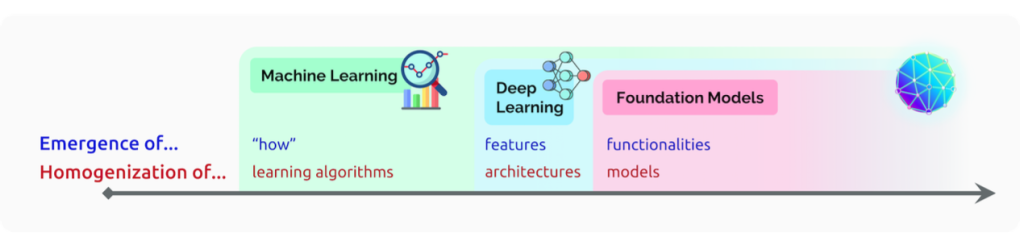
Source: https://arxiv.org/abs/2108.07258

Key MaaS Mechanisms to Test

The frenzy of activity is currently all about experimentation, riding the possibilities of emergence, mitigating risk, and finding use cases. We recommend also developing a strategy for how this technology can create, capture, and distribute value to ecosystem stakeholders. 

MaaS Models in Use

Amazon Web Services (SageMaker) | Google Cloud AI | Microsoft Azure AI | OpenAI API | Hugging Face | IBM Watson | NVIDIA AI Enterprise | DataRobot | C3.ai | Clarifai | Seldon | Runway | Scale AI

Why Customers Like MaaS:

Benefits for Customers

  • Convenience: Pre-trained AI models eliminate the need for extensive in-house development and expertise.
  • Accessibility: Affordable, on-demand access to advanced machine learning models via APIs or platforms.
  • Cost Efficiency: Pay-as-you-go pricing avoids large upfront investments in infrastructure or talent.
  • Customization: Many services allow for fine-tuning models with proprietary data to meet specific needs.
  • Speed to Deployment: Pre-trained models enable faster implementation of AI-driven solutions, reducing time to market.
  • Scalability: Models can be scaled up or down based on business needs without the need for additional infrastructure.

Why Companies Like MaaS:

Benefits for Companies

  • AI as a High-Growth Opportunity: MaaS positions companies in a booming AI market, tapping into demand from organizations across industries looking to adopt AI solutions. 
  • Market Differentiation: Offering unique, specialized AI models helps companies stand out in competitive markets.
  • Data Insights: Regular usage generates valuable customer data, improving model accuracy and identifying future opportunities.
  • High Potential Margins: Once developed, AI models can be delivered at scale with minimal additional cost operationally, but high capital expenditures often mean the company will struggle with return on invested capital. 
  • Customer Lock-In: Customers often rely on proprietary AI solutions, increasing long-term retention.

What do Investors Think of MaaS?

Why Investors May Like Models-as-a-Service

  • Scalability: Once models are trained and deployed, scaling to new customers has low incremental costs.
  • High Lifetime Value (CLTV): Dependence on ongoing AI solutions creates high customer retention and profitability.
  • Exponential Growth Potential: MaaS aligns with the rapidly growing demand for AI applications across industries.
  • Cross-Industry Application: Models serve diverse sectors, increasing market potential and reducing dependency on any single industry.

Why Investors May Be Skeptical

  • Churn Risk: Customers may cancel subscriptions if they perceive limited ongoing value.
  • High Development Costs: Initial costs of building high-quality AI models can be significant, with high capital expenditures and fears that these business will never achieve profitability, despite model efficiency improvements. 
  • Competitive Pressure: The AI-as-a-service space is crowded, and suffering from hype, making differentiation critical.
  • Data Privacy Concerns: Mismanagement of customer data could lead to reputational and regulatory risks.
  • Model Commoditization: AI models may become standardized, eroding pricing power.
  • Intellectual Property Risk: Much like at the start of the Internet, concerns about underlying copyright protection for data sources used to train these models is considered a regulatory risk. 
  • High Environmental Costs: Fears that the water and energy usage required to run these models may be contrary to investors seeking alignment with impact goals. 

MaaS KPIs:

  • Monthly Recurring Revenue (MRR): Tracks predictable income from subscriptions.
  • Customer Retention Rate: Indicates how many customers continue to use the service over time.
  • Model Usage Metrics: Measures the frequency and intensity of API calls or service requests.
  • Customer Acquisition Cost (CAC): Evaluates the cost of gaining a new subscriber.
  • Churn Rate: Tracks the percentage of customers who stop using the service.
  • Time-to-Deployment: Measures how quickly customers implement the AI models in their workflows.
  • Cost per Model Deployment: This KPI measures the average cost of training, fine-tuning, and deploying an AI model, including compute, storage, and energy expenses. Tracking this metric helps assess how efficiently the company is managing its infrastructure and optimizing CAPEX investments over time.

Challenges to the MaaS Model

Compared to the introduction of the commercial internet in the 1990s, the sudden apperance of AI has been met with greater resistance – outlined below. 

  • High Compute Costs: Training and deploying advanced AI models require significant computational resources, resulting in high capital expenditures (CapEx) for infrastructure, GPUs, energy, and cloud services. As models become larger and more complex, these costs can escalate rapidly, straining profitability and creating barriers for smaller MaaS providers.
  • Fear of Job Displacement: AI adoption is often associated with automation replacing human jobs, creating resistance among workers and organizations.
  • Existential Threat Concerns: A number of statements from scientists and tech leaders warned that artificial intelligence poses an existential threat to humanity. “Mitigating the risk of extinction from AI should be a global priority alongside other societal scale risks such as pandemics and nuclear war.” This is in contrast to bias and harm researchers who point to the threat that may be unleashed from further deployment of AI without addressing the consequences. 
  • Bias and Inequities in AI: Concerns about AI models reinforcing systemic bias or producing inequitable outcomes can erode trust and deter adoption.
  • Data Privacy and Security Risks: Sharing sensitive data with third-party providers raises concerns about breaches, misuse, and compliance with privacy laws.
  • Lack of Trust in AI Decision-Making: The “black box” nature of AI can make outputs difficult to interpret, causing hesitancy in relying on AI for critical decisions.
  • High Skepticism Toward Overpromises: Customers wary of AI hype may resist investing in MaaS solutions due to fear of unmet expectations.
  • Hallucinations: Large Language Models: These models generate outputs that are factually incorrect, fabricated, or nonsensical, even when the input data does not support such conclusions. This issue is particularly common in large language models (LLMs) like GPT or LLaMA, which are designed to predict and generate plausible-sounding text.
  • Workforce Transition Complexity: AI adoption often requires retraining employees, which can be costly and culturally challenging for organizations.
  • Regulatory and Compliance Barriers: Inconsistent global AI regulations create risks, especially in industries with strict compliance standards like healthcare or finance.
  • High Competition and Commoditization: With similar offerings from multiple providers, customers may struggle to see the value or differentiation in MaaS solutions.
  • Ethical Concerns About AI Use Cases: Negative perceptions of AI’s potential misuse (e.g., surveillance, manipulation) can hinder adoption.
  • Cultural Resistance to Change: Many organizations face internal resistance when integrating AI into established workflows and decision-making processes.
  • Perceived Loss of Control: Outsourcing AI capabilities to external providers can make organizations feel dependent and vulnerable.
  • Customization Complexity: Fine-tuning AI models for individual customer needs can strain resources.
  • Data Privacy and Security: Customers must trust the provider to handle sensitive data responsibly.
  • High Competition: Many companies offer similar AI capabilities, increasing the need for differentiation.
  • Market Education: Customers may not fully understand the benefits or applications of MaaS, slowing adoption.
  • Regulatory Hurdles: Compliance with data protection and AI-specific regulations varies across regions and industries.

Strategic Responses to MaaS Challenges

  • Invest in Model Efficiency and Compression: Focus on developing or fine-tuning smaller, more efficient models that require less computational power without sacrificing accuracy. Adopt technologies like model distillation or pruning to reduce training and inference costs.
  • Adopt Hybrid Infrastructure Strategies: Use a mix of on-premises and cloud-based compute infrastructure to balance CAPEX and OPEX. On-premises solutions can mitigate long-term compute costs for predictable workloads.
  • Data Privacy and Security: Customers must trust the provider to handle sensitive data responsibly.
  • Promote Augmentation Over Automation: Frame AI as a tool to enhance human capabilities rather than replace them. Highlight success stories where AI has created new roles rather than eliminating jobs.
  • Prioritize Ethical and Human Rights Principles and Practices: Implement rigorous fairness, accountability, and transparency practices during model development to address concerns about bias. Go beyond ethics to adopt a human rights framework that prioritizes the detection and mitigation of bias in AI models but leaves these decisions up to the creators of the model. A human rights framework goes further to acknowledge universal human rights, ensuring universality – human rights are universal and apply to all people in the world, right to equality and non-discrimination, participation, transparency, accountability and remedy. 
  • Adopt Zero-Trust Data Security Models: Ensure robust data privacy and security measures, such as encryption, secure APIs, and compliance with global standards like GDPR and HIPAA. Communicate these safeguards clearly to customers to alleviate privacy concerns.
  • Rigorously Test Pricing Models, Qualitatively and Quantitatively: Value will be in the eye of the customer, not the company. Conduct interviews with executives and operational users to understand perceived value. Experiment with dynamic pricing models to align costs with customer ROI and usage patterns.
  • Differentiate Through Vertical Expertise: Focus on specialized AI solutions for high-value industries (e.g., healthcare, finance, retail) rather than generic offerings. Partner with industry leaders to co-develop and validate your models.
  • Adopt Value-Based Pricing Models: Address concerns about high costs and competitive pressure by offering pricing structures aligned with customer outcomes, such as pay-per-success or performance-based models.
  • Cost Competition: Open-source AI models can reduce barriers to entry for competitors and customers, making it harder for proprietary MaaS providers to justify premium pricing.
  • Community-Driven Innovation: Open-source models benefit from a global community of developers, driving faster improvements and creating robust ecosystems.
  • Build Trust Through Explainability: Invest in user-friendly dashboards and tools that visualize model outputs and decisions in an understandable way, reducing the “black box” effect and increasing customer confidence.

Before You Consider MaaS

  • Do you have access to a data model that can be pre-trained? 
  • Do you have a value proposition? A proposed workflow to change? A human to augment? 
  • How will you address potential bias and implement mechanisms to ensure fairness? 

Testing the Model

  • Do you have early adopters identified to test your model? 
  • Do you have a complimentary business model hypothesis (pay-per-use, subscription, other) to test?
  • Can our MaaS solution be used by developers, or by business users with no or low code skills?? 

More on MaaS

Transform Your Business Model Today

Is Models-as-a-Service right for you? Let's assess your fit and path to funding.