
On forecasting, portfolios, and futures
“We need to spend more time on Horizon 2,” they both say.
One is a program officer at a climate and nature philanthropy. The initiatives they’re funding risk being captured by the dominant political economy in the U.S. or co-opted by greenwashing actors who sound like they are marching toward progress but are aggressively resisting any change to the status quo.
The other is the CFO of a massive industrial company. The core business is slowing. The R&D pipeline is funded with hopeful AI bets and blockchain projects that failed to prove out, but new commercial launches have stalled. Growth in the next three to five years looks tenuous. They have nothing in the pipeline to address customer demands for more “resilient infrastructure,” so competitors are taking their share of the market.
They are both working hard, collaborating with their teams and partners to make sense of a disoriented world with compounding uncertainties.
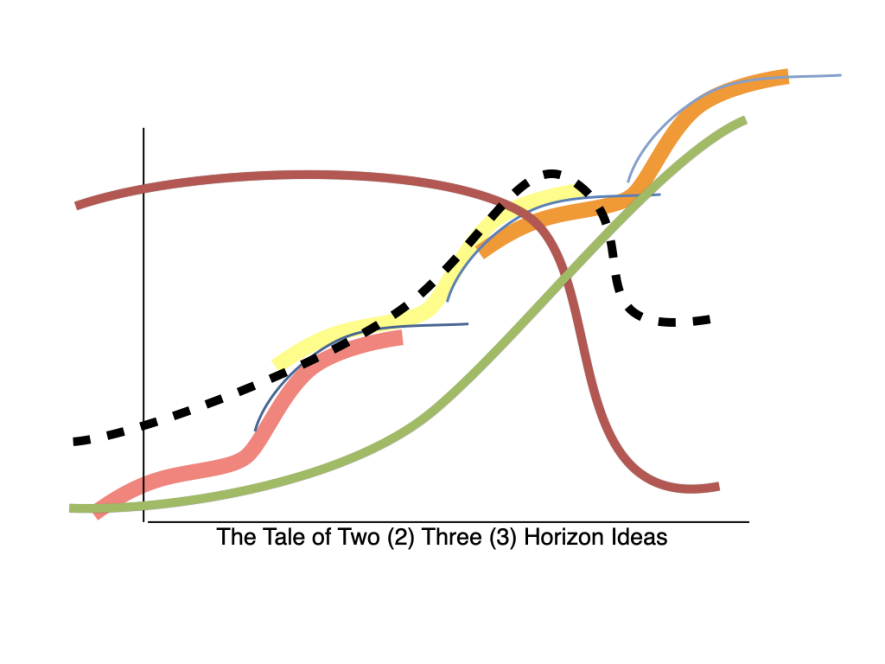
They’re using different frameworks that happen to share the same name.
A discussion on LinkedIn on different framing of narratives led to further comments about the problem of “H2 capture” – so I thought I’d spell them out for folks because both ways of seeing horizons in time can help with the bridge work that needs to be done to move us from where we are to where we need to be.
McKinsey’s Three Horizons: Managing Innovation Portfolios
I first encountered talk of horizons during the dot-com recovery period. Companies had gotten over their skis, investing in the shiny promise of the internet future, only to ratchet back spending to focus on their dependable core businesses once the crash came. Growth had stalled.
The framework’s insight, published in The Alchemy of Growth by McKinsey consultants Baghai, Coley, and White (2000), was portfolio thinking for innovation investment: protect the core, grow the adjacencies, and seed the experiments. Manage not just risk and return, but time itself.
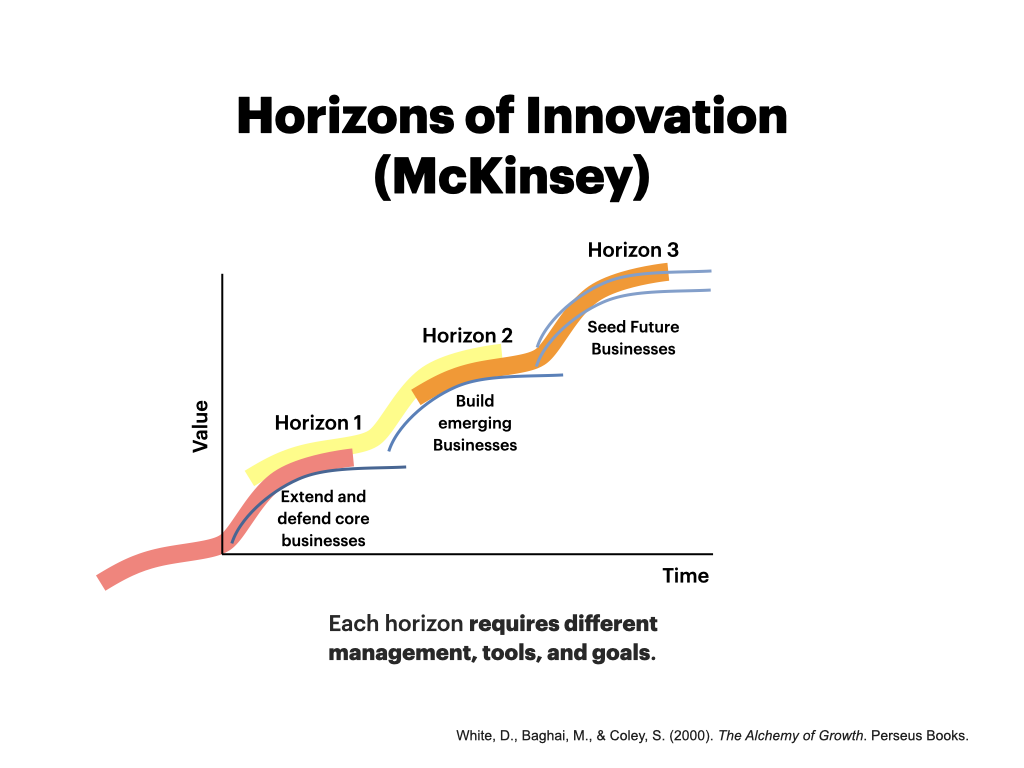
The framework maps how organizations manage innovation across time horizons.
Horizon 1 is the core business — the reliable revenue generator.
For Disney, this was parks, films, and merchandise. Protect it. Optimize it. Capture value from it. Most of your revenue, and most of your certainty, lives here.
Horizon 2 is emerging growth. These are projects that may become meaningful revenue streams in three to five years, beyond proof of concept but not yet scaled. They often leverage core capabilities into adjacent markets or new business models.
Disney’s MagicBand and FastPass systems were classic Horizon 2 plays. In the boardroom, they looked like brilliance: a wristband that improved park experiences, enabled payments, and created a data infrastructure for personalization.
Outside the boardroom, the meaning shifted. Was this a premium queue-jumping perk in a public space — the pinnacle of the American dream, or a symbol of its erosion? A way to monetize access to experiences that families once shared on equal terms?
But there’s no critical theory in these decision rooms, no one pointing out that an operational innovation had encoded inequality into leisure itself, transforming waiting in line from a shared ritual into a sorting mechanism. It’s all shareholder portfolio logic. Any backlash is absorbed into the calculus of revenue and margin growth, as well as into what the company can contribute to shareholder portfolios.
Horizon 3 is the far future, the moonshots. The experiments that might fail, pivot, or eventually redefine the core seven to ten years out.
When Disney began building Disney+, it was Horizon 3: a direct-to-consumer streaming model that cannibalized its own lucrative cable and theatrical windows. It was a hedge against an uncertain distribution of future income.
But today, investors are asking: What story is Disney telling about the future?
The brand is embattled on all sides of the political spectrum. The recent loss of more than two million Disney+ subscriptions following the FCC controversy and Jimmy Kimmel’s temporary cancellation underscored that the company’s cultural and financial narratives are intertwined. Some investors now worry that Disney has no “sexy AI story” and no clear way to reinvent itself the way the tech giants have promised.
The Three Horizons framework gave language to tensions that had always existed: today versus tomorrow, optimization versus exploration, certainty versus possibility. Its power, and its trap, is that it translates those tensions into portfolio logic.
Sharpe’s Three Horizons: Futures as Transformation
There’s another way to work with the idea of horizons, one that treats the future not as a portfolio problem but as a systems change challenge.
Developed by Bill Sharpe, Anthony Hodgson, Graham Leicester, and colleagues at the International Futures Forum, this version of the Three Horizons framework looks at transformation across time as a living process: how dominant systems decline, how emerging alternatives take root, and how we navigate the turbulent space in between.
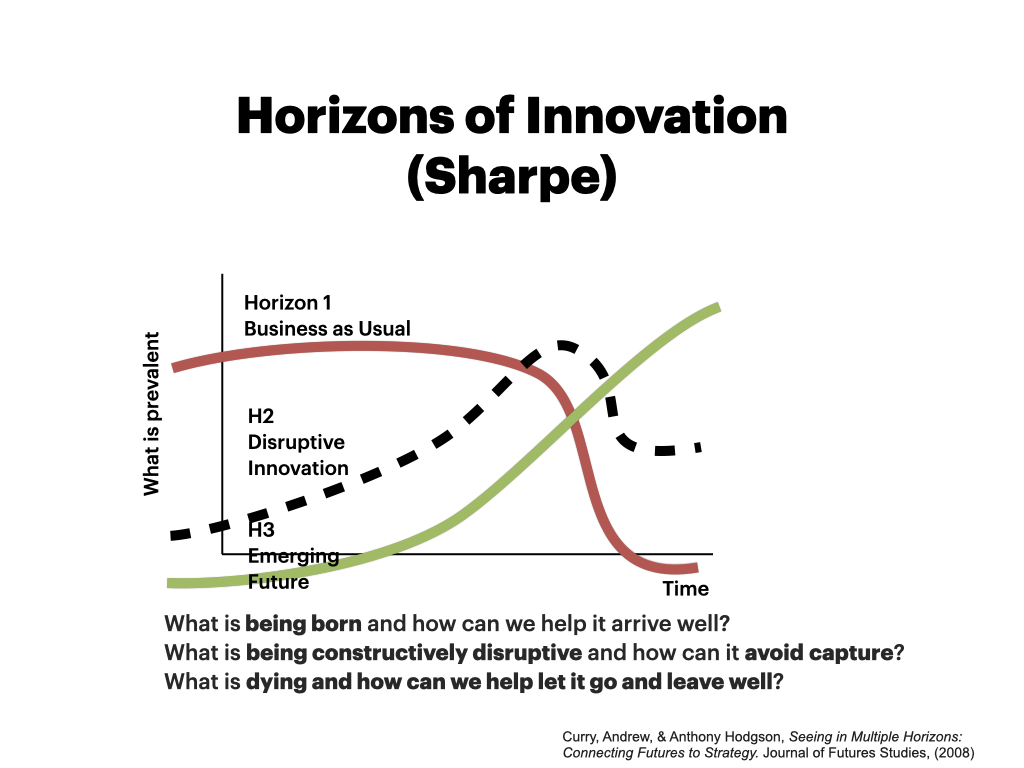
Horizon 1 represents the dominant system — the world as it currently operates.
For the climate philanthropy program officer, this might mean the fossil-fuel economy and the extractivist logics that sustain it. The unit of analysis is not a single organization but a system of actors: governments, corporations, intermediaries, and advocates. Horizon 1 still generates enormous inertia and wealth, even as its cracks show in ecological, social, and political terms.
Horizon 3 is the emerging future, the seeds of transformation already at work.
These might include cooperative ownership models, bioregional economies, participatory budgeting, or energy democracy initiatives. They are not incremental innovations to plug into the current system; they are prefigurative, enacting the futures they imagine. They live on a small scale now, but they embody fundamentally different organizing logics.
Horizon 2 is the turbulent transition zone.
It is where the old resists collapse and the new fights to emerge. It is where most of the action and strategic ambiguity reside. Actors in this space are trying to extend the lifespan of H1, accelerate the growth of H3, or navigate between them.
Instead of a boardroom exercise, this work is practiced as a collective visioning process, a way to develop shared pathways for systems change. The program officer may be participating in a horizon exercise organized by one of their grantees, or convening their own session to understand how their portfolio of grants supports broader transformation.
For the program officer, “spending more time in Horizon 2” means something specific. It means not funding only Horizon 1, reformist tweaks within the current system, or only Horizon 3, beautiful but isolated experiments. It means resourcing pathways of transformation: the strategies that shift power, change rules, and make room for H3 to grow. It means investing in the infrastructure of transition, in sustainable economic structures that enable community self-determination, not just one-off pilots or narrative-change campaigns easily co-opted by incumbents.
Sharpe’s framework is not about balancing risk and return. It is about understanding and accelerating transformation.
It asks:
• How does a system actually change?
• Where are the leverage points?
• Who benefits from H1’s persistence?
• What helps H3 gain legitimacy?
In this version, the Three Horizons are not a corporate portfolio map. They are a lens on collective evolution, an invitation to see the future as something we grow into, not something we manage only for future cash flows.
Bridging the Two
Both of them are correct. We do need to spend more time in Horizon 2.
In the McKinsey version, Horizon 2 is a bridge that keeps the organization viable as conditions change. It’s not just for companies, but for any organization that relies on funding, customers, or support. It helps you see that your primary source of revenue (USAID?) is a big risk if you have no plan B. It is where resilience is built, not through cost-cutting, but by developing the next sources of strength. It treats uncertainty as something to be managed and monetized. The goal is continuity, not reinvention.
In the Sharpe version, Horizon 2 is also a bridge, but between systems. It is where people test new rules, new forms of ownership, and new forms of value. It treats uncertainty as material for transformation. The goal is renewal, not continuity.
Both frameworks make time actionable, but each inherits the logic of its origin. One assumes stability must be protected; the other assumes it must be undone. Each has blind spots. Portfolio logic often cannot see beyond capital preservation. Transition logic can underestimate the persistence of power and the path dependency of incumbent infrastructure.
For those of us working inside systems that are both stable and failing, both productive and destructive, Horizon 2 is not a theory. It’s the terrain we work in every day. The bridge has to hold while we rebuild what crosses it.
The task is not to choose between resilience and transformation, but to connect them, to design bridges that can carry value, capability, and legitimacy across change.
If your work is truly about systems change, you can’t just be a portfolio manager. You have to be a transition actor, willing to disinvest from what must decline, to risk failure in service of what might emerge, to accept that Horizon 2 is not the “safe middle” but the most dangerous, contested, and necessary terrain.
The conclusion, then, is not comfortable. Most organizations using the Three Horizons language are using it to avoid this very reckoning. The framework becomes a way to sound strategic while remaining safe, to fund a “portfolio of change” that never actually threatens the distribution of power.
But when you understand what transition really requires, when you see Horizon 2 not as “emerging growth” but as the destabilization of everything that resists change, the work demands something else.
Not balance, but courage.
Not diversification, but commitment.
Not managing innovation, but midwifing transformation, knowing you cannot control what emerges, only whether you help it or hinder it.None of us can stay at the edges of this work. Horizon 2 belongs to everyone who allocates resources, tells stories, or sets priorities for the future.
The invitation is to move from describing transition to practicing it, to use whatever authority, access, or capital we have to build bridges that serve more than our own survival.
From: Contribution Design, A field guide for people who create and adapt systems of value and valuation. Subscribe here.
Narrative as an Allocative Force, on LinkedIn, thoughtful discussion in the comments, referencing H2 language. https://www.linkedin.com/feed/update/urn:li:activity:7387124667205181440/
White, D., Baghai, M., & Coley, S. (2000). The Alchemy of Growth. Perseus Books.
Curry, A. (2008). Seeing in Multiple Horizons: Connecting Futures to Strategy. Journal of Futures Studies.