
Dr. Bryant Lin teaches medicine at Stanford. He founded the Center for Asian Health Research and Education to study diseases that disproportionately affect Asian populations, including nonsmoker lung cancer. Then he was diagnosed with it himself. He is now Stage 4. His doctor prescribed Rybrevant, an FDA-approved treatment for his specific mutation. Aetna denied the claim. Lin, a physician at … Read More
The Tale of Two (2) Three (3) Horizon Ideas
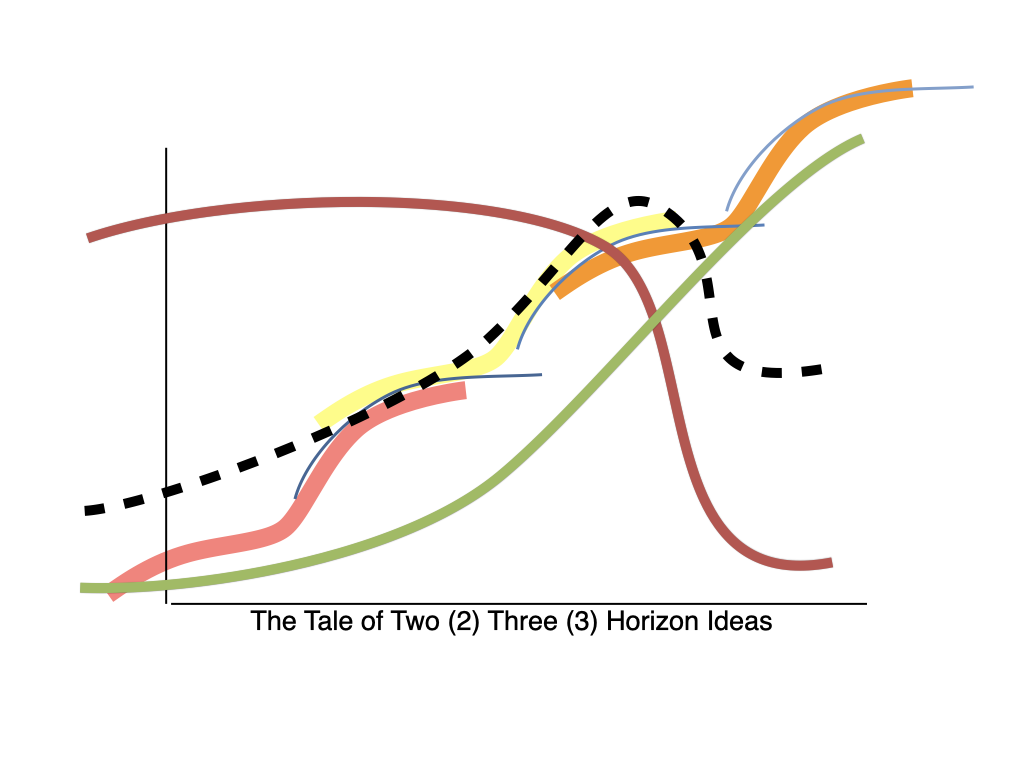
On forecasting, portfolios, and futures “We need to spend more time on Horizon 2,” they both say. One is a program officer at a climate and nature philanthropy. The initiatives they’re funding risk being captured by the dominant political economy in the U.S. or co-opted by greenwashing actors who sound like they are marching toward progress but are aggressively resisting … Read More
Narrative, Valuation, and the Material Power of Finance

“Narrative change” has become its own sphere in philanthropy and movement work, stories as culture, identity, and legitimacy. Narrative work is funded. Those with the best narratives attract funding. There’s even been a backlash against narrative-building, and last week I had a set of compelling conversations thanks to Julia Roig’s post on Judith Mil’s post, a materialist critique of narratives. … Read More
Outcomes Will Be Contested

Performing Economic Realities: Climate Week on Value, AI, and the Contest Over Contribution My worlds all collided at Climate Week, and it’s taken me another week to metabolize the bafflement of many and find the corners of coherence, trying to remember more than the variation of seating charts, convening experiences, and which rooms were set to Arctic tundra versus tropical … Read More
Who Shapes the Machine Dreams

A story about unimaginative visions for efficiency and who gets to decide what intelligence serves. The machines are learning. But not what you think. The machines are learning how to hollow out human work and pour the profits into distant accounts. The machines are learning the language of efficiency, which means “we don’t need you anymore.” The machines are learning … Read More
The Double-Edged Sword of Outcomes-Based Models

A compelling narrative is emerging in business and finance: a shift from funding effort to paying for results. On the surface, outcomes-based models, results-based finance, and impact-linked finance appear to be a logical evolution toward greater efficiency and accountability. This approach, however, is not a panacea. It’s a complex tool whose application merits careful critique, as it can create as … Read More
The Business Model of LLMs is… People?

AI’s Consulting Confession: When “Revolutionary” Tech Needs Human Handlers So the business model answer to the LLM era of so-called AI is… consulting? OpenAI recently launched enterprise consulting services, charging at least $10 million per client, deploying “Forward Deployed Engineers” who embed directly with organizations, a model that mirrors Palantir’s approach of rebranding IT services integration with military-grade language. This … Read More
Alternative Construction and Beyond

Pattern One: Delete. Pattern Two: Capture. Pattern Three… The signs are everywhere, if you know where to look. A German state announces it’s done with Microsoft Teams. A billionaire venture capitalist podcasts a manifesto justifying the rule of tech elites. AI researchers scramble to prevent a “data winter.” These might seem like disconnected events, but they reveal something deeper: three … Read More
Will Outcomes-Based Models Accept the Blame?

Limits to paying only for the results that count Imagine signing a contract that promises “no results, no bill,” only to discover later that “results” were defined by someone else, measured with flawed data, and delivered through a system you barely control. Outcomes-based models promise perfect alignment: you pay only for success, and your solution provider is fully on the … Read More
Escaping to BlueSky? Check the business model, first

Positioned as a non-billionaire alternative to the centralized chaos of X.com and Meta, Bluesky has gained attention as a Public Benefit Corporation (PBC). It promises better community monitoring, a more welcoming digital environment, and a protocol-based escape from traditional platforms. Yet beneath the surface lies a tangle of open-source ideals and crypto-capitalist investors that may shape its governance and trajectory. … Read More